Wolf Igniter clicking — Meaning & Fix
On Wolf units, Igniter clicking means A surface burner clicks but will not light (a symptom rather than a numeric code). It is usually caused by wet or dirty burner cap/port. You can safely dry and clean the burner cap and ports, make sure the cap is seated correctly. Because continued clicking after cleaning usually means an igniter or spark-module replacement., you generally need a technician to confirm the exact part. Code text and behavior vary by model and generation, so verify against your service guide or call (650) 484-4687.
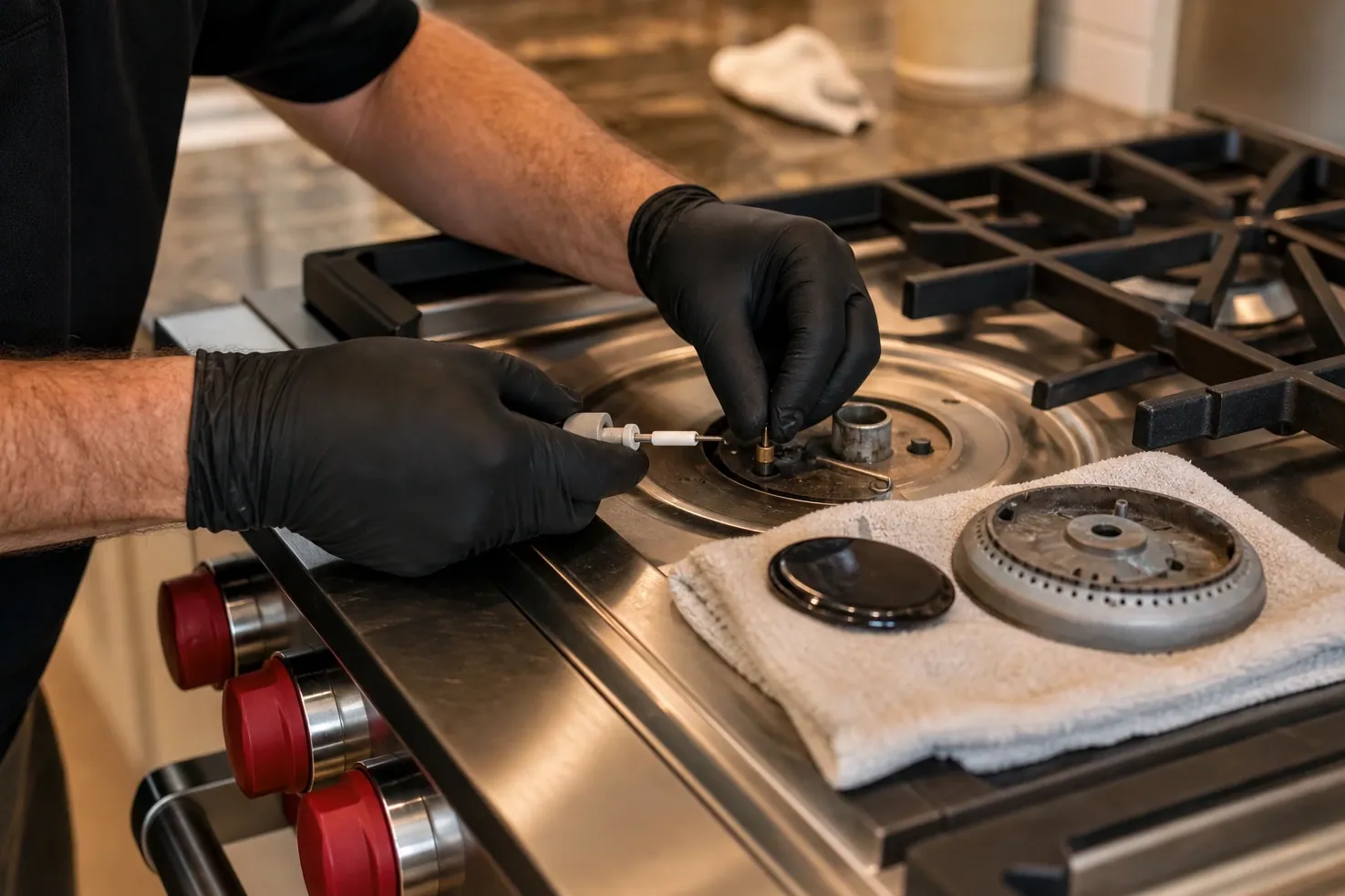
What Igniter clicking means
A surface burner clicks but will not light (a symptom rather than a numeric code).
Continuous clicking from a Wolf surface burner means the igniter is sparking but the burner isn’t lighting. It is a symptom rather than a numeric code. The good news is the most common cause — a wet or dirty cap — is owner-fixable. If clicking continues after cleaning and drying, or if a burner clicks with the knob off, the igniter or spark module is involved and needs service.
The exact code text and behavior vary by model and generation — confirm against your unit’s service guide or call (650) 484-4687.
Likely causes, explained
A technician works through these from the most common and least costly toward the ones that need testing. Here is what each one actually means for your Igniter clicking:
- Wet or dirty burner cap/port Moisture or food debris on the burner cap or in the ports is the most common cause — and the easiest to fix by drying and cleaning.
- Worn igniter A worn igniter electrode may spark weakly or inconsistently, so the gas takes too long to light or won’t catch.
- Spark module fault A faulty spark module can make one or all burners click continuously, even when the knob is off, and usually needs replacement.
What you can safely check
- 1
Photograph the exact panel text — including every digit — before you do anything. The specific code is what lets a technician match it to your model.
- 2
Dry and clean the burner cap and ports, make sure the cap is seated correctly.
- 3
Note whether the appliance is still heating and write down any temperatures or unusual behavior. That context speeds up the diagnosis.
Safe rule of thumb: clean and inspect, but never open sealed refrigerant lines, bypass a gas safety, or force a locked-out oven to run. If the Igniter clicking condition persists after the steps above, stop and book a diagnosis rather than swapping parts on a guess.
What to expect from a service visit
A typical Wolf Igniter clicking call runs in a predictable order. The technician reads the stored code in service mode, then tests the implicated parts with a meter rather than relying on a generic online lookup — important here, because Igniter clicking can mean different things across model generations.
- Confirm the exact code and read live data in service mode
- Test the suspect parts to isolate the true cause before any quote
- Present a written quote — you approve before any work begins
- Fit genuine OEM parts and verify the code clears under load
The $89 service call is waived (deducted) from the total when you proceed, and labor is backed by a 365-day labor warranty. We dispatch independent specialists across San Francisco, the Peninsula, Silicon Valley, the South Bay, the East Bay, and Marin — most Wolf calls are same-day.
When to call a technician
Continued clicking after cleaning usually means an igniter or spark-module replacement.
An independent Wolf technician reads the specific sub-code in service mode, tests the implicated parts, and fits genuine OEM components following manufacturer service specifications. The $89 service call is waived with the repair, backed by a 365-day labor warranty.
On which Wolf models
Igniter clicking appears on Wolf ranges, cooktops, and wall ovens, but the exact wording, the entry/exit sequence, and what the code maps to differ by model and model year. A value that means one subsystem on an older control can mean something else on a newer one after a software revision. That is the single most important caveat with this code.
The exact code text and behavior vary by model and generation — confirm against your unit’s service guide or call (650) 484-4687.
Related Wolf codes
If you are cross-checking symptoms, these related Wolf alerts often appear in the same subsystem and are worth reading alongside Igniter clicking:
- F-code (oven) — An oven control fault code (F followed by a number) on Wolf ranges and wall ovens.
For symptom-based help, see our appliance troubleshooting guides. Full coverage lives on our Wolf range & oven repair page, and typical part-and-labor ranges are on the Sub-Zero repair cost guide.
- Service call
- $89, waived with repair
- Warranty
- 365-day warranty on all labor
- Parts
- Genuine OEM parts
- Service area
- the San Francisco Bay Area
- Hours
- Same-day in most areas · 7 days
- Call
- (650) 484-4687
Wolf Igniter clicking — recent repairs
A few jobs that started with this exact Wolf code or alert.
Igniter clicking questions
Why does my Wolf burner keep clicking but won’t light?
The igniter is sparking but the gas isn’t catching. The most common reason is moisture or food debris on the burner cap or in the ports — often after cleaning or a spill. A worn igniter or a faulty spark module can also be the cause. Start by drying and cleaning the cap and ports and making sure the cap is seated correctly; that resolves most clicking.
How do I clean a Wolf burner cap and ports safely?
Turn the burner off and let it cool. Lift off the burner cap and the grate, wipe away food residue, and clear the small ports around the burner with a straightened paperclip or a soft brush — never something that could break off inside. Make sure everything is fully dry before reseating the cap squarely. Trapped moisture is the number-one cause of persistent clicking.
My Wolf burner clicks even when the knob is off — is that dangerous?
A burner that clicks with all knobs off points to a faulty spark module or a stuck switch, not a simple cleaning issue. There’s no flame, but continuous sparking is abnormal and should be addressed. As a precaution you can shut off the burner at the breaker or gas supply if it’s persistent, and book a technician — this typically needs a spark-module or switch replacement.
I dried and cleaned the cap but it still clicks — what now?
If a thorough clean and dry doesn’t stop the clicking, the igniter electrode is likely worn or the spark module is failing. A worn electrode sparks weakly or inconsistently so the gas can’t light; a bad module sparks erratically. Both need replacement with genuine Wolf parts. Note which burners are affected — that helps the technician decide between an igniter and the shared module.
Should I smell for gas if the burner won’t light?
Yes — if the burner clicks without lighting, gas can pool. Turn the knob off, wait, and let any gas disperse before trying again. If you smell a strong, persistent gas odor, do not operate the cooktop, ventilate the area, and contact your gas utility or a professional. For ordinary clicking with no strong odor, cleaning the cap is the safe first step.
How much does it cost to fix a clicking Wolf burner?
Cleaning is free and often solves it. If a part is needed, an igniter is typically less involved than a shared spark module. Diagnosis starts at $89, waived when you proceed, with a quote first. Genuine OEM Wolf igniters and modules and a 365-day labor warranty apply, so a stubborn clicking burner becomes a reliable one again.