Burner clicks but won't light
The spark snaps but the gas is slow to catch — usually moisture under the cap, a clogged port or a tired spark module rather than a control board.
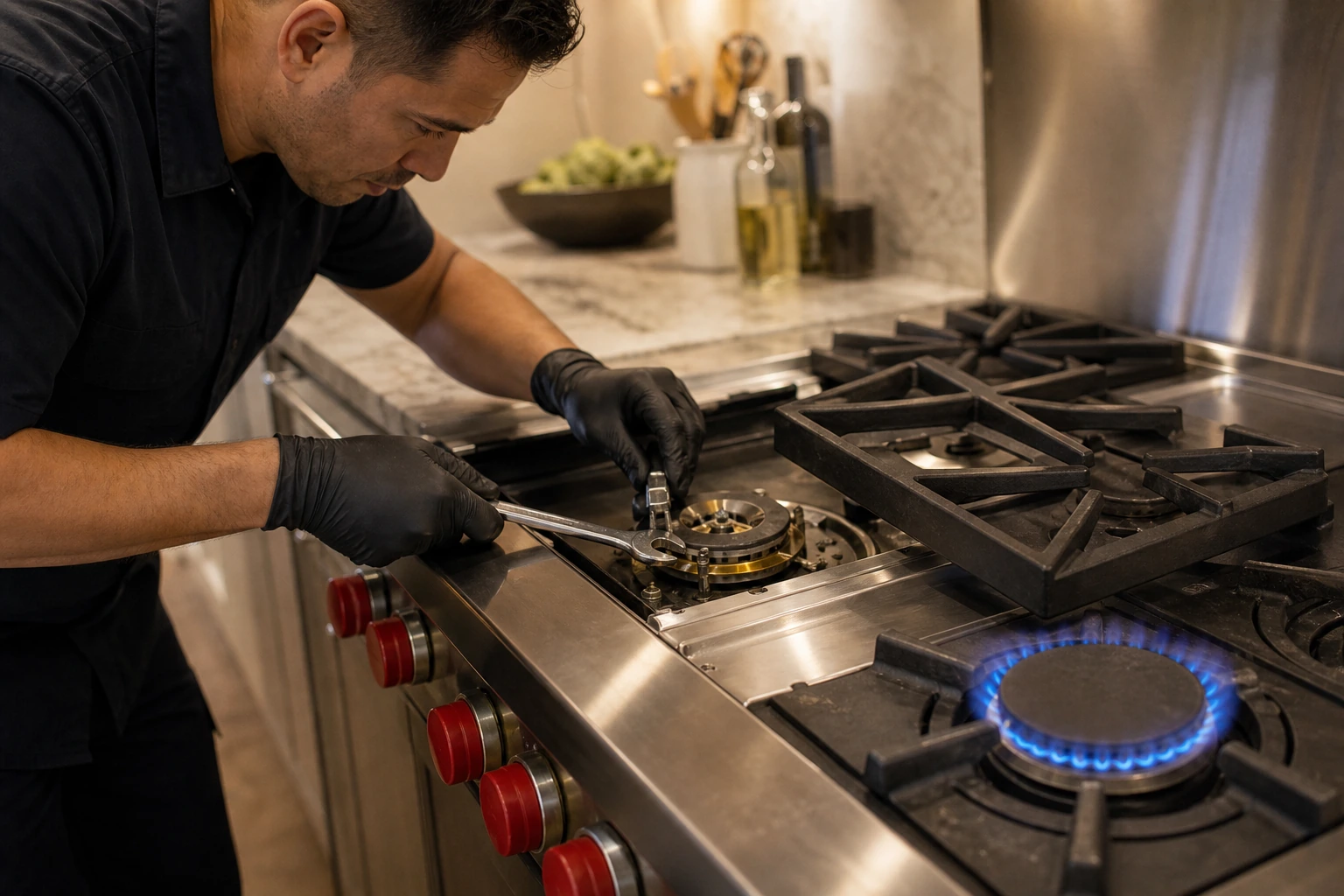
Dual-fuel and all-gas ranges — ignition, oven heat and control faults, fixed right the first time.
Wolf ranges fail at the cooktop far more often than the cabinet — a sealed burner that sparks but won't catch, a dual-fuel oven that drifts off its setpoint, or an F-code that locks the panel. We repair Wolf dual-fuel and all-gas ranges across the Bay Area, usually same-day, with genuine OEM igniters, elements and control parts on the van, and the $89 service call is waived once you approve the repair.
The spark snaps but the gas is slow to catch — usually moisture under the cap, a clogged port or a tired spark module rather than a control board.
On a dual-fuel range an aging bake or broil element, a drifting oven probe or a convection-fan fault leaves roasts under- or over-done.
A flashing F-series code shuts the oven down. We read it against your model's service data to separate a sensor fault from a control-board failure.
A burner that flares or dies on the lowest setting points to a clogged brass orifice or a surface valve that has drifted out of adjustment.
A faint odor, a flame that lifts off the port or a slow-opening valve is a safety issue — we pressure-check the manifold and the burner valves.
Dead illuminated knobs, an unresponsive control or a relay stuck closed leave a burner or the oven stuck off — or stuck on.
| Wolf range family | What we cover |
|---|---|
| Dual Fuel (DF) 30–60" | Gas sealed burners over an electric dual-convection oven — igniters, elements, oven probe, control board. |
| All-Gas (GR) ranges | Sealed-burner gas top with a gas convection oven — surface ignition, safety valve and oven glow-bar igniter. |
| Griddle / French-top / grill models | Modular griddle, French top and infrared grill inserts — thermostats, burner assemblies and even heat-up. |
| Dual-stacked sealed burners | Dual-stacked burner ignition, true-simmer calibration and brass-port cleaning. |
| Legacy 30" / 36" ranges | 15–20-year-old ranges diagnosed against their own service data, with parts confirmed by model and serial. |
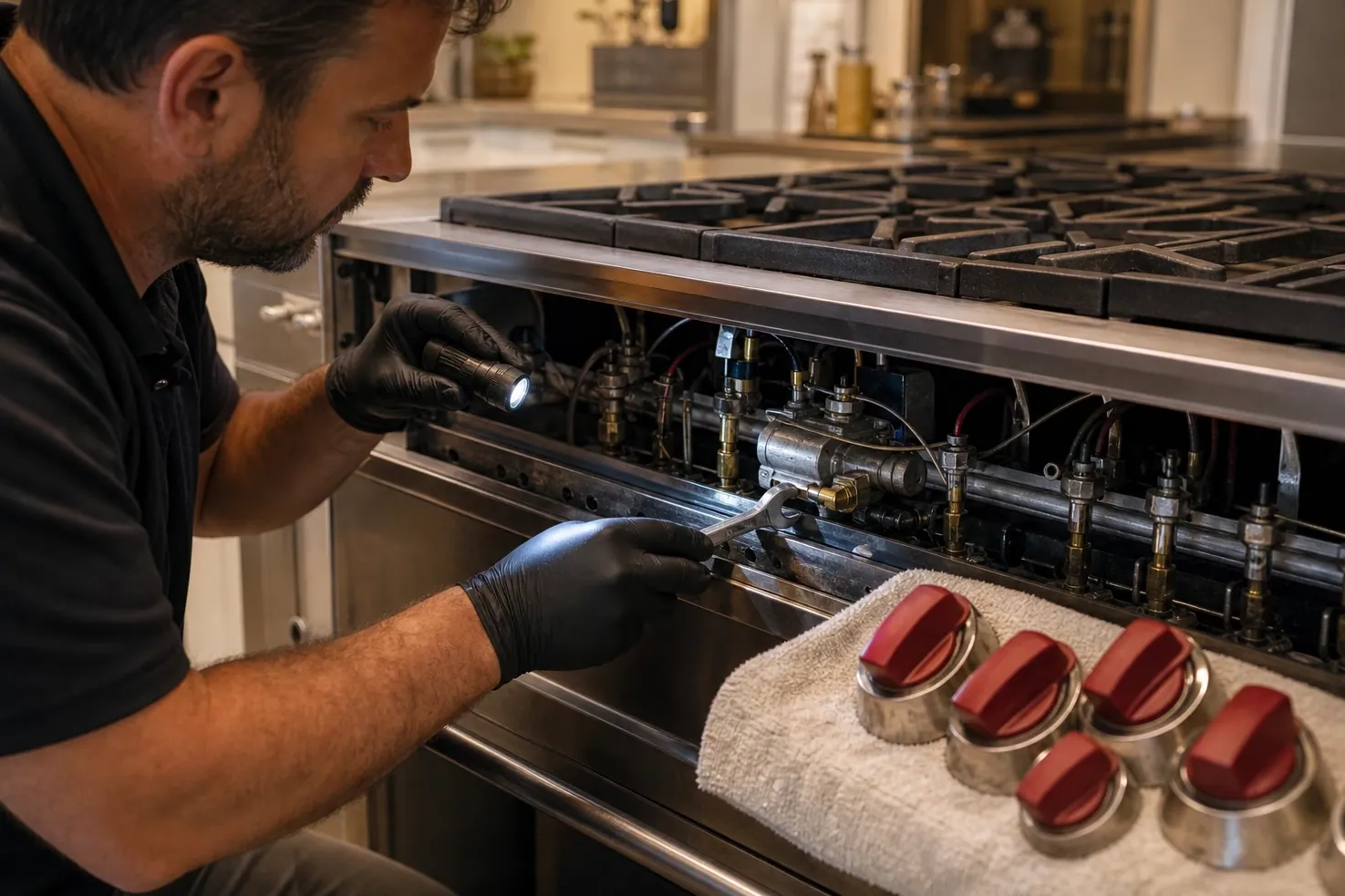
The single biggest variable on a Wolf range is what sits under the cooktop. A dual-fuel (DF) model pairs gas sealed burners with an electric dual-convection oven, so its oven faults live in the bake and broil elements, the temperature probe and the control board. An all-gas (GR) range heats its oven with a gas burner and a glow-bar igniter instead, which changes the failure pattern entirely — a weak igniter, not a burnt element, is what usually leaves the oven cold. We confirm which configuration you own before quoting, because bringing an element to a gas-oven call (or the reverse) is exactly the wasted trip we work to avoid. For the heating side specifically, our Wolf oven not-heating walkthrough breaks down what each symptom is pointing at.
A surface burner that clicks without lighting is the most common Wolf range complaint we see, and it is rarely the expensive part owners fear. The spark electrode fires across a small gap to ignite the gas; when moisture from a recent spill or cleaning bridges that gap, the igniter keeps snapping while the flame is slow to catch. A burner cap knocked slightly off-center after washing does the same thing, as does a port clogged with boil-over. When drying, reseating and clearing the ports does not solve it, the suspect moves to the spark module shared across the burners — if every burner clicks at once, that module is almost always the cause. If the cooktop is a standalone unit rather than a range, our Wolf cooktop & rangetop repair page covers it, and any F-series code is decoded against your model rather than guessed at.
Wolf dual-fuel ranges anchor a lot of the kitchens we work in, from Burlingame and San Mateo remodels to the larger estate kitchens of Atherton, Hillsborough and Palo Alto where a 48- or 60-inch range with a griddle or French top is the centerpiece. Those ranges are built around a heavy chassis that long outlasts the consumer-grade parts inside, so an igniter, element, thermostat or control board is almost always a parts-level repair rather than a reason to replace a five-figure appliance. We carry common igniters, spark modules, bake and broil elements and oven sensors on the truck, give you an itemized price before any work, and back the labor with a 365-day warranty. When a range genuinely is at the end of its life we say so — our repair-or-replace guide walks the math, and typical part-and-labor ranges live in the repair cost guide.
A few minutes of safe checks often narrows the fault and, now and then, fixes it outright. None of these involve gas lines, refrigerant or live electrical work — those stay with a technician.
Check the breaker is on and the gas shutoff is open, then see whether the other burners light — that tells us instantly whether the fault is one burner or the whole range.
Switch the burner off, let any moisture under the cap evaporate, and set the cap squarely back on its base. A cap sitting off-center is a frequent cause of endless clicking.
With the burner cool, clear the small flame ports with a wooden toothpick — never a metal pin, which can widen a port and distort the flame ring.
Note the model and serial from behind the kick panel or on the oven frame, plus the exact code on the display, so we arrive with the right revision of parts.
If you smell gas, or a burner will not light at all, turn it off, open a window, and leave the diagnosis to a technician rather than forcing it.
Anything beyond these checks is a job for a technician. Call (650) 484-4687 with your model and serial and we will confirm parts and the soonest window.
Yes. We service Wolf dual-fuel (DF) ranges with electric ovens and all-gas (GR) ranges with gas ovens, in 30 to 60-inch widths, including models with a griddle, French top or grill module. Because the two heat their ovens differently, we confirm your configuration first so the right igniter, element or sensor is on the van.
Most often it is moisture trapped under the burner cap after a spill or cleaning, a cap sitting slightly off-center, or a port clogged with boil-over. If drying, reseating and clearing the ports does not fix it, the shared spark module is the likely culprit — especially if every burner clicks at once. It is a common, bounded repair, not a reason to replace the range.
On a dual-fuel Wolf the oven is electric, so uneven baking traces to a weakening bake or broil element, a convection fan, or a temperature probe reading out of range. We test the heating circuit and probe against spec, replace only the part that is actually off, and verify the oven holds its setpoint before we leave.
Note the exact code and your model number, then call. F-series codes flag a control fault, but the precise meaning varies by range generation, so we decode it against your model service guide rather than assuming. The code narrows it to a sensor, wiring or the control board, and we verify the circuit before replacing the board, which is the costliest part.
Usually, yes. Wolf ranges are built on a heavy chassis that outlives the igniters, elements and boards inside, so a repair is almost always cheaper than replacing a professional range that can cost five figures. We give an honest repair-or-replace read when a unit is genuinely near the end, rather than selling parts you do not need.
We offer same-day or next-day service across San Francisco, the Peninsula, Silicon Valley and the East Bay in most areas. The service call is $89 and is waived when you book the repair; final pricing depends on the model and the parts involved, and you get an itemized quote before any work begins.
Independent service disclaimer. Wolf and Sub-Zero are registered trademarks of their respective owners. Sub-Zero, Wolf and Viking Appliance Services is an independent repair company and is not affiliated with, authorized by, or a factory service center for Wolf or Sub-Zero Group, Inc. We install genuine OEM parts and follow manufacturer service specifications.