No ice at all
A closed water valve, a frozen or kinked supply line, or an ice-maker module that has stopped cycling leaves the bin empty.
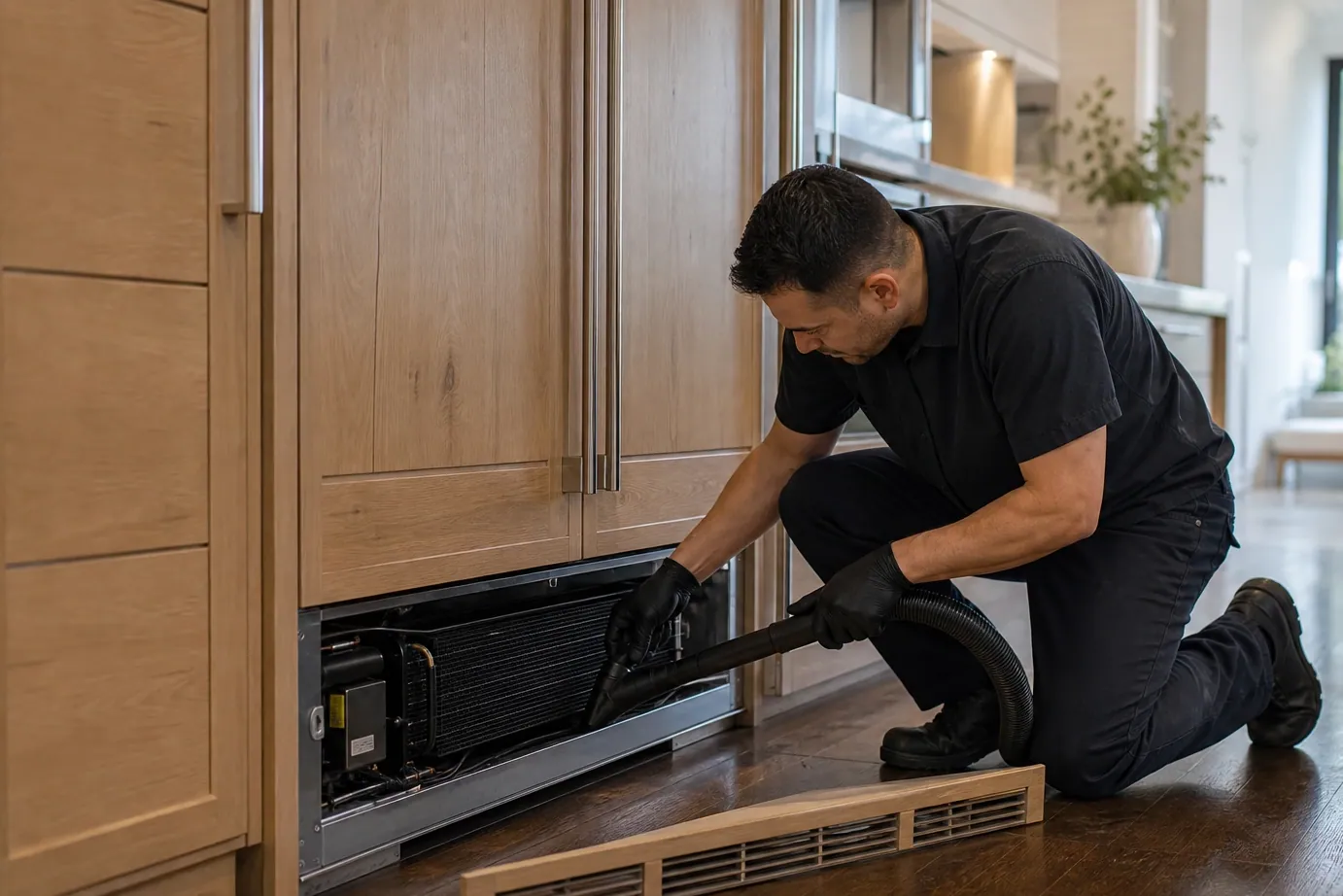
No ice, low production or hollow cubes — supply, module and harvest faults found in order.
A Sub-Zero that makes no ice, or only a thin trickle, almost always has a water-supply, module or cabinet-temperature issue — not a failed refrigerator. We repair the ice systems in Sub-Zero built-in refrigerators and dedicated ice makers across the Bay Area: water inlet valves, ice-maker modules, water lines and filters, and the clear-ice systems in standalone units. Genuine OEM parts, a 365-day labor warranty, and a $89 service call that is waived when you book the repair.
A closed water valve, a frozen or kinked supply line, or an ice-maker module that has stopped cycling leaves the bin empty.
Thin or partial cubes usually mean low water pressure, a clogged filter, or a compartment running a touch too warm to harvest.
Stale or odd-tasting ice points to an old water filter or a supply line due for a flush, not the cooling system.
A module that cycles without ejecting cubes, or a stuck ejector arm, is a contained module or harvest-motor repair.
Cloudy, hollow or scale-flecked cubes in hard-water areas trace to mineral buildup at the inlet valve and fill tube.
A weeping inlet valve or a cracked fill tube drips behind or under the cabinet — a small part now prevents floor damage later.
| Sub-Zero ice system | What we cover |
|---|---|
| Built-in (BI) refrigerator ice makers | In-freezer ice modules on BI-36/42/48 units — module, inlet valve, fill tube and water line. |
| PRO & Classic ice makers | Professional and legacy in-cabinet ice makers — harvest motor, thermostat and supply. |
| Designer column & drawer ice makers | Integrated column and drawer ice systems — module and water routing. |
| UC-series standalone ice makers | Undercounter clear-ice makers — water system, pump, cleaning cycle and drain. |
| Water lines, valves & filters | Inlet valves, saddle and line connections, filters and the cabinet-temperature dependency. |
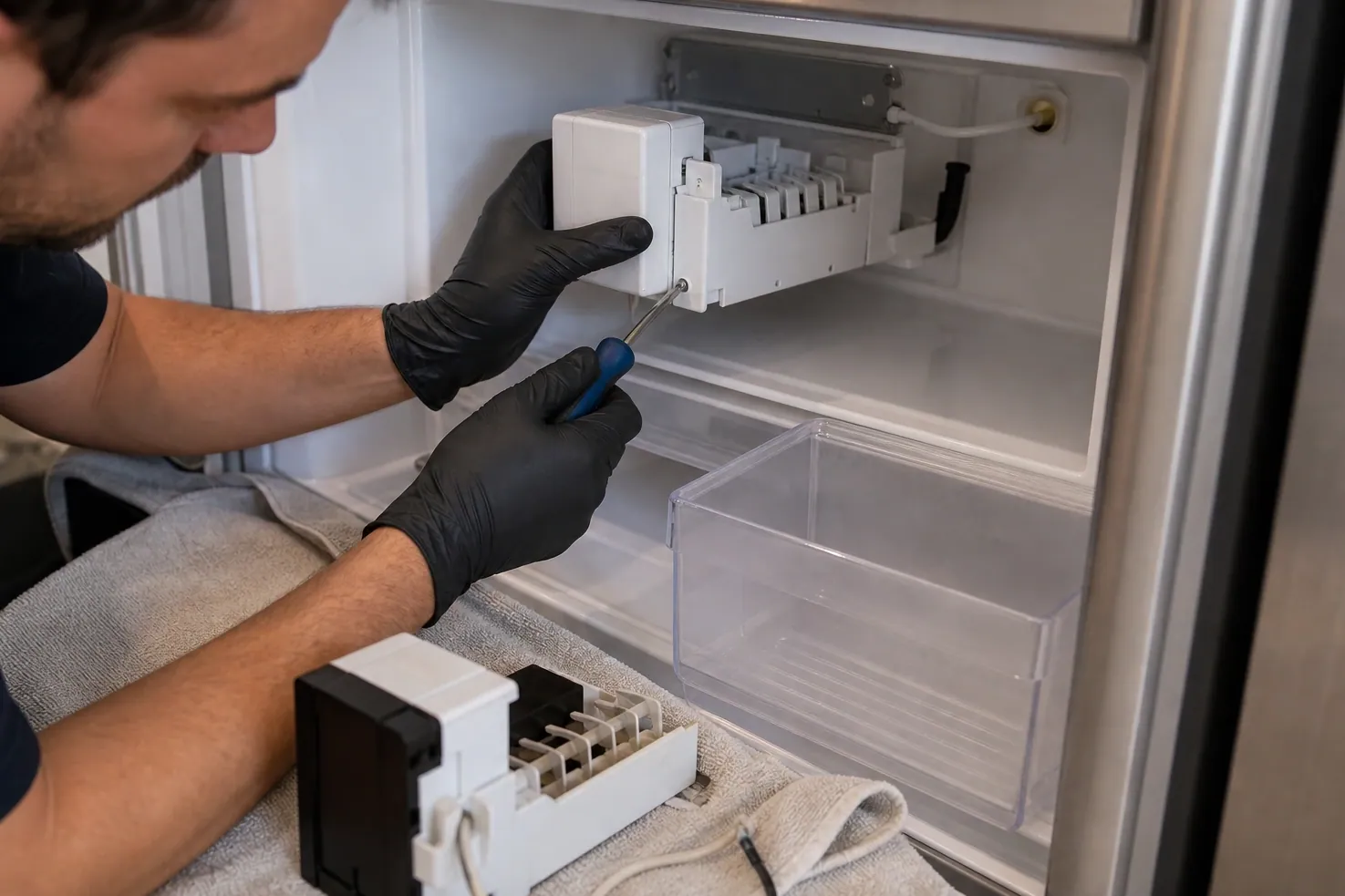
Ice production is a small chain of dependencies, and a break anywhere in it empties the bin. Water has to reach the maker through an open inlet valve and an unobstructed line; the ice-maker module has to cycle, fill, freeze and harvest on schedule; and the compartment has to be cold enough for the harvest thermostat to release the cubes. When ice stops entirely, we work that chain in order — supply first, then the module, then cabinet temperature — because the cheap, common causes sit at the start of it. A built-in that has otherwise been cooling perfectly almost never needs a sealed-system repair to fix its ice; the fault is local to the water and harvest path. The fastest way to narrow it before we arrive is our ice-maker not working guide.
Two very different machines wear the same name. The ice maker inside a built-in, PRO or Classic refrigerator is a compact in-freezer module fed by a water line, and most of its faults are the module itself, the inlet valve or a fill tube that freezes shut. A standalone undercounter unit is a dedicated clear-ice machine with its own water system, pump, cleaning cycle and drain, designed to produce gourmet cubes — its faults skew toward the pump, the water reservoir and scale in the cleaning circuit. We confirm which you have before quoting, since a module that fixes a built-in has nothing to do with the pump on a UC-series maker. Either way the repair is bounded; neither is a reason to replace the appliance.
Much of the Peninsula and South Bay runs moderately hard water, and over years that mineral content quietly shapes ice-maker failures. Scale builds at the inlet valve and along the fill tube, narrowing the opening until cubes come out hollow, undersized or flecked, and a filter left in past its interval makes it worse and taints the taste. These are inexpensive parts — an inlet valve, a fill tube, a filter — when caught early. We carry common Sub-Zero ice-maker modules, valves and water-line parts on the van, so most ice repairs finish in one visit, and we will tell you honestly when a fresh filter and a line flush are all a unit needs. Typical part-and-labor ranges are in the cost guide, and the broader Sub-Zero refrigeration service covers cooling faults beyond the ice system.
These quick checks often explain a no-ice or low-ice call without a visit, and they keep you clear of the sealed system, which stays with a technician.
Sub-Zero ice makers have an on/off switch or arm; make sure it is enabled and the bin is seated, so the maker is not being told it is already full.
Verify the household shutoff to the refrigerator is open and check the water filter age — a clogged or overdue filter starves the maker. Replace it if it is past interval.
After a power loss, a filter change or a move, a maker can take a full day and a few cycles to refill and drop its first batch. Wait before assuming a fault.
If you can safely see the fill tube, check for an ice plug bridging it. A recurring plug points to the valve or a too-warm compartment for us to diagnose.
If there is still no ice, or you see water pooling, record the model and serial and call rather than dismantling the module yourself.
Anything beyond these checks is a job for a technician. Call (650) 484-4687 with your model and serial and we will confirm parts and the soonest window.
When the refrigerator is cold but the bin is empty, the fault is almost always in the ice system itself, not the sealed system. The usual causes are a closed or weak water inlet valve, a frozen or kinked supply line, or an ice-maker module that has stopped cycling. We work the supply, then the module, then compartment temperature to find it.
Undersized, hollow or cloudy cubes usually mean the maker is not getting enough water, most often from low pressure, an overdue filter, or scale narrowing the inlet valve and fill tube. In our moderately hard Bay Area water that buildup is common. Replacing the valve or filter and flushing the line typically restores full, clear cubes.
Give it about 24 hours. After a power loss, a move, or a new filter, a Sub-Zero ice maker needs time to refill, freeze and run a few harvest cycles before the first full batch appears. If there is still no ice after a day with the maker switched on and the water on, it is worth a diagnosis.
Yes. A filter left in past its interval restricts flow and can taint the taste, which shows up as small cubes and off-flavored ice. We recommend replacing the filter on schedule, and on a no-ice or low-ice call it is one of the first inexpensive things we check before looking at the valve or module.
Yes. Beyond the in-freezer modules in built-in refrigerators, we service undercounter clear-ice makers — the dedicated units with their own pump, water reservoir, cleaning cycle and drain. Their faults skew toward the pump, scale in the cleaning circuit and the harvest motor, all of which are bounded, genuine-part repairs.
The service call is $89 and is waived when you book the repair; most ice-system parts — an inlet valve, a fill tube, a module or a filter — are modest, and we carry the common ones on the van so many repairs finish in one visit. We offer same-day or next-day service across the Bay Area in most areas.
Independent service disclaimer. Sub-Zero, Wolf and Cove are registered trademarks of Sub-Zero Group, Inc. Sub-Zero, Wolf and Viking Appliance Services is an independent repair company and is not affiliated with, authorized by, or a factory service center for Sub-Zero Group, Inc. We install genuine OEM parts and follow manufacturer service specifications.