One zone drifts warm
On a dual-zone unit the reds zone holds while the whites zone creeps up — usually a drifting zone sensor or a damper that no longer modulates.
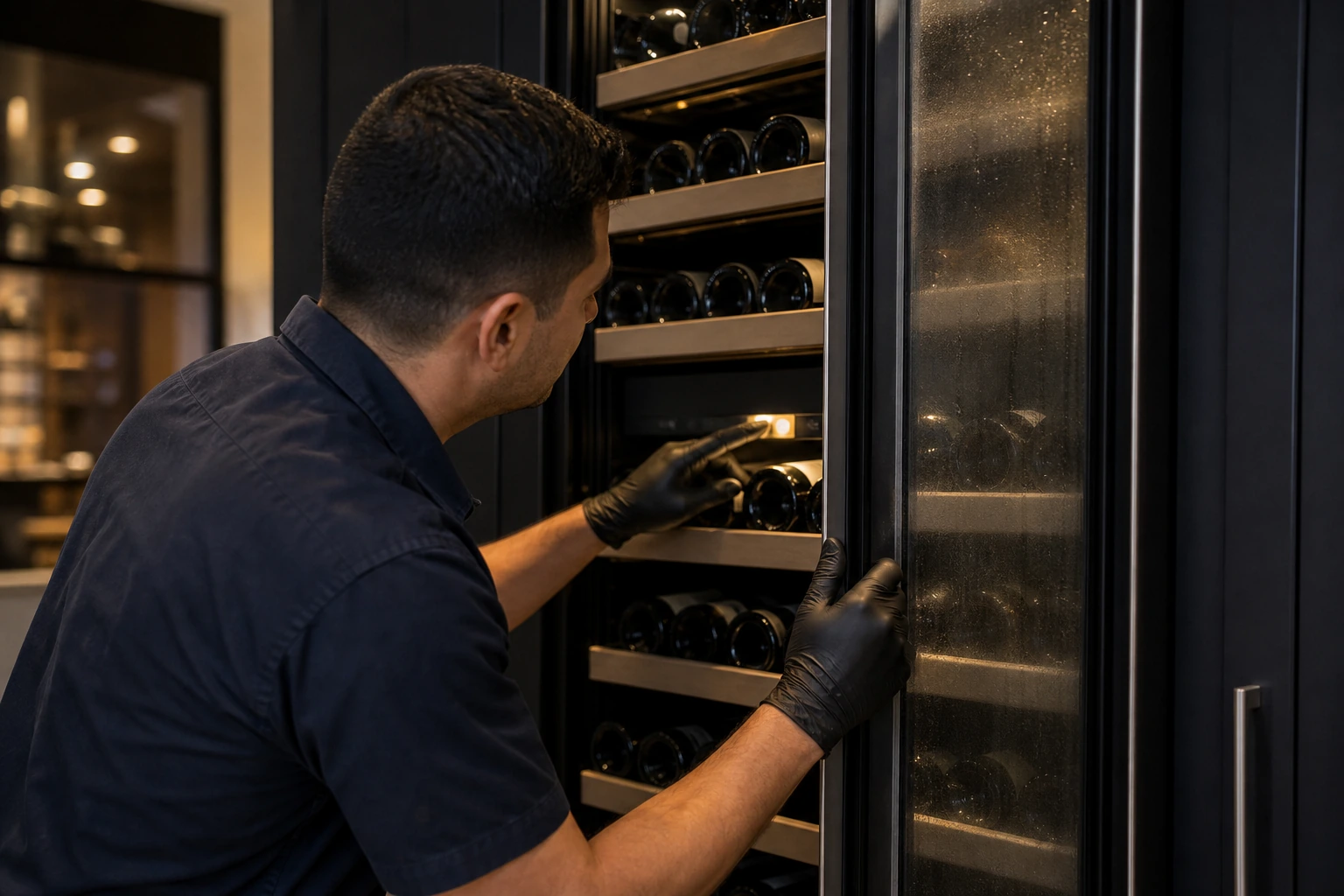
Wine columns and dual-zone storage — temperature drift, sensors, airflow and seals, diagnosed before parts.
A Sub-Zero wine unit that drifts off its set temperature, runs one zone warm or sweats at the door is almost never a lost collection — it is a sensor, a damper, an airflow or a seal problem, and each is a bounded repair. We service Sub-Zero built-in wine columns, dual-zone units and undercounter wine storage across the Bay Area with genuine OEM parts. The $89 service call is waived when you book the repair, and every job carries a 365-day labor warranty.
On a dual-zone unit the reds zone holds while the whites zone creeps up — usually a drifting zone sensor or a damper that no longer modulates.
A unit that cannot reach set point, especially on a hot afternoon, often has a condenser choked with dust or a tired evaporator fan.
Non-stop running points to airflow, a door that no longer seals, or a sealed-system issue — we measure before quoting any major part.
A stiff gasket or a glass-door seal that no longer pulls flush lets warm kitchen air leak in, showing as condensation or a faint frost line.
A blank panel, unresponsive touch controls or a unit that will not power up is usually the control board or supply, not the cooling system.
A growing hum from a compressor mount or a fan bearing transmits into the racks and, over time, disturbs sediment in older bottles.
| Sub-Zero wine unit | What we cover |
|---|---|
| 424 / 427 / 430 wine columns | Integrated and tall wine columns — zone sensors, dampers, evaporator fan and door seal. |
| Designer wine columns | Panel-ready integrated columns flush with cabinetry — control board and temperature accuracy. |
| Dual-zone undercounter units | Undercounter dual-zone wine storage — independent zone control and humidity. |
| Classic / legacy wine units | 15–20-year-old wine units diagnosed against their own service data. |
| Combination wine & refrigerator drawers | Mixed wine-and-refrigerator designer units — separate sealed-circuit diagnosis. |
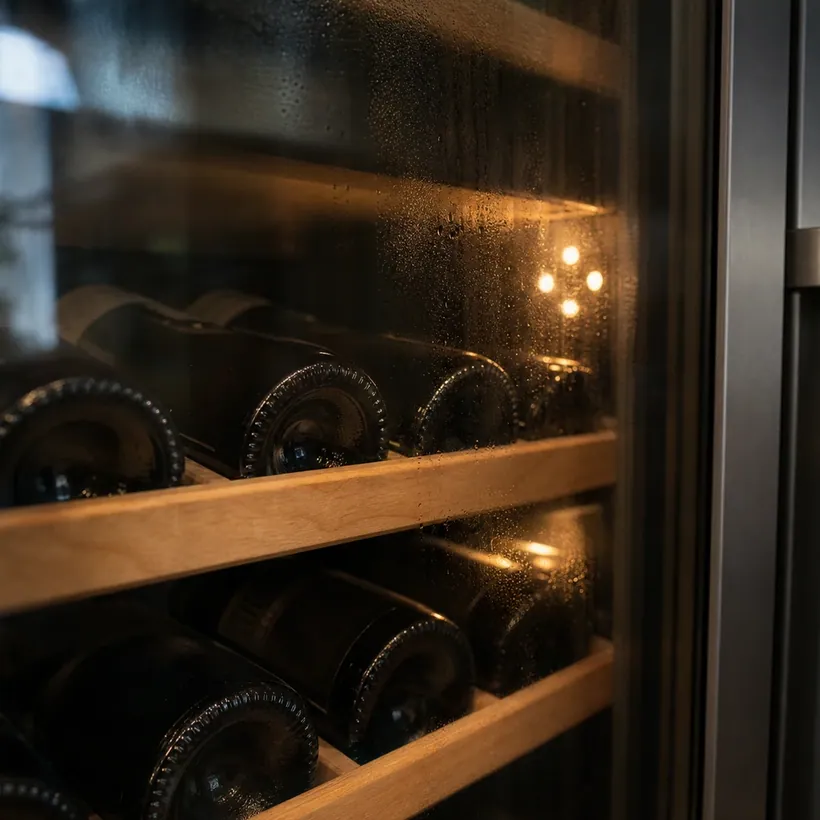
Sub-Zero wine storage comes in two broad shapes, and the repair starts with knowing which you own. The tall integrated columns — the 424, 427 and 430 families and their designer panel-ready versions — drop flush into cabinetry and usually offer two independently set zones for reds and whites. Undercounter units pack the same idea into a 24-inch footprint beneath a counter. Both run their two zones from a single sealed system, balanced by a motorized damper and a pair of temperature sensors, which is why the most common complaint — one zone warm while the other holds — is a control-loop problem rather than a failed compressor. We confirm the model and configuration first so the diagnosis fits the unit in your kitchen. For the symptom in detail, see our wine-unit running-warm guide.
When a dual-zone unit loses its reference, the cause is almost always small. A zone thermistor reading a few degrees off, or a damper that sticks instead of modulating cleanly, lets the two compartments converge or one drift up — we read both sensors against a calibrated probe before replacing anything, because chasing a forty-dollar sensor with a new control board is the guess we refuse to make. The other half of wine-unit calls are about airflow. The condenser behind the grille sheds heat into the room, and in a kitchen that pulls cooking grease or sits in the Peninsula damp it cakes over a couple of seasons, so the unit holds temperature on a cool morning but drifts up on the first warm afternoon. A slowing evaporator fan leaves the top shelves warmer than the bottom even when the compressor is fine. Each of these is a clean, OEM-part repair.
A lot of the wine units we service hold serious collections in Burlingame, Millbrae, Hillsborough and the Atherton estates, where a single integrated column can be guarding a five-figure cellar and a sustained two-degree excursion is enough to make an owner reach for the phone. Wine keeps best dark, still and steady, so beyond temperature we check the door gasket and UV-glass seal for leaks, and we listen for the quiet enemy — a compressor mount or fan bearing whose growing buzz transmits vibration into the racks and unsettles sediment over months. Most faults here are bounded repairs worth making in a built-in column matched to a cabinetry surround you would not want to disturb. We give an honest read when a 15-year-old undercounter unit is near the end of its sealed-system life; the Burlingame wine-cooler guide and the cost guide go deeper, and the wider Sub-Zero refrigeration service covers the rest of the kitchen.
These checks help tell a quick recovery from a real fault, and keep you clear of the sealed system and live electrical work, which stay with a technician.
After a door left ajar, a big restock, or a new setpoint, a wine unit can need up to a day to recover. Note whether it stabilizes before assuming a fault.
Place a thermometer in each zone for a few hours and compare to the display. A consistent gap, or one zone clearly off, tells us where to look.
Switch the unit off, pull the lower grille, and gently vacuum the condenser with a soft brush to restore airflow — the single highest-value thing an owner can do.
Confirm the door closes fully and the gasket seals all the way around; a bottle, a rack out of position or a tired seal can hold it open a crack.
If the unit has grown audibly louder or a zone stays warm after these checks, note the model and serial and book a diagnosis before a vintage is at risk.
Anything beyond these checks is a job for a technician. Call (650) 484-4687 with your model and serial and we will confirm parts and the soonest window.
On a dual-zone unit each compartment has its own temperature sensor and shares a motorized damper that splits the cold air. One warm zone usually means a sensor reading a few degrees off or a damper that is not modulating cleanly — both bounded repairs, not a failed cabinet. We verify each zone against a calibrated probe before replacing anything.
That pattern almost always points to airflow. The condenser behind the grille sheds heat into the room, and once it cakes with dust or kitchen grease it cannot keep up when the room itself warms. Cleaning the condenser and checking the evaporator fan usually restores a steady set point without major parts.
A brief excursion rarely harms a collection, but sustained warmth and repeated swings age wine faster and can eventually push corks. If your unit has been off its set point for more than a day or two, it is worth diagnosing promptly rather than waiting for it to fail outright, especially with valuable bottles.
Yes. A stiff door gasket or a UV-glass seal that no longer pulls flush lets warm, light kitchen air leak in, which shows as condensation or a faint frost line along an edge. We replace the seal with a genuine OEM part and confirm the door closes tight, since a leaking door makes the whole cabinet work harder.
Usually, especially an integrated column built flush with cabinetry. A sensor, damper, fan, gasket or board is a fraction of replacing the unit and disturbing the surround. We give an honest read when a 15-year-old undercounter unit is near the end of its sealed-system life, but most wine-storage faults are well worth fixing.
Sub-Zero makes the built-in wine columns and undercounter wine storage; Wolf is the cooking side of the family and Cove makes the dishwashers. We service all of them across the Bay Area, so a kitchen that pairs a Sub-Zero wine column with a Wolf range can be handled on a single visit.
Independent service disclaimer. Sub-Zero, Wolf and Cove are registered trademarks of Sub-Zero Group, Inc. Sub-Zero, Wolf and Viking Appliance Services is an independent repair company and is not affiliated with, authorized by, or a factory service center for Sub-Zero Group, Inc. We install genuine OEM parts and follow manufacturer service specifications.