Runs cold or slow to preheat
A tired bake element or a probe reading high leaves the cavity below the set temperature no matter what the display says.
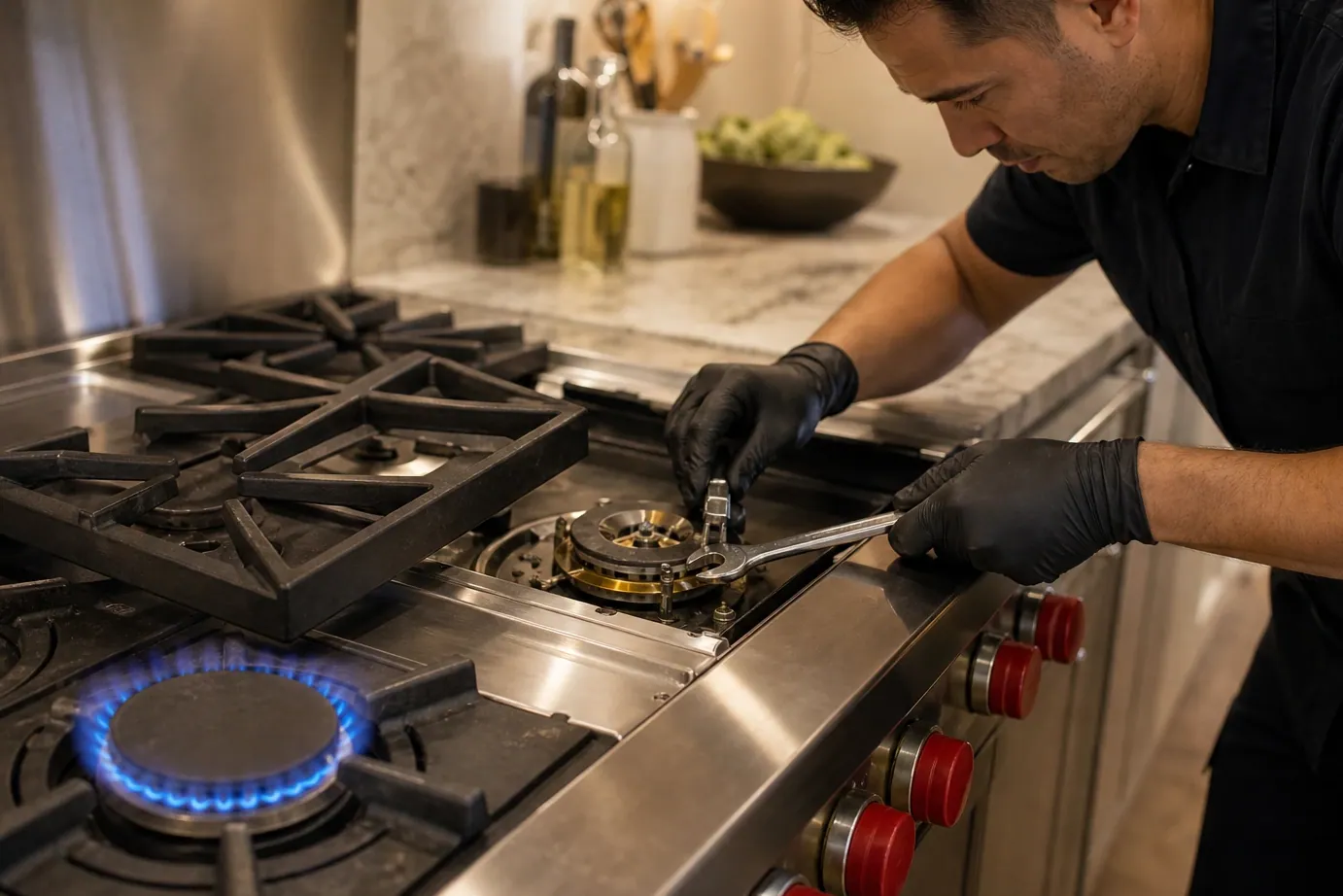
Wall ovens and range ovens — elements, calibration, convection and control faults put right.
A Wolf oven that bakes cold, browns on one side or flashes an F-code is almost always a calibration or element problem, not a dead appliance. We repair Wolf built-in wall ovens and the ovens inside dual-fuel ranges across the Bay Area — bake and broil elements, temperature probes, convection fans, door seals and control boards — with genuine OEM parts and a 365-day labor warranty, and the $89 service call is credited to the repair when you go ahead.
A tired bake element or a probe reading high leaves the cavity below the set temperature no matter what the display says.
A failing convection fan or motor, or a broil element that only partly lights, bakes one side of the pan faster than the other.
A broil element burned through at one end, or a relay that no longer closes, leaves the top heat dead while the bake function still works.
An F-series fault or a stuck door-lock motor can shut the oven out entirely — we decode it against the model before touching the board.
A flattened gasket or a sagging hinge lets heat leak, so the oven over-runs to hold temperature and the front panel gets hot.
A self-clean cycle that refuses to begin, or a door that stays locked afterward, is usually the lock motor, thermal fuse or control — not the whole oven.
| Wolf oven type | What we cover |
|---|---|
| E Series built-in wall ovens | Single and double electric convection wall ovens — elements, probe, fan, door and control board. |
| M Series wall ovens | Contemporary and Professional M Series — touch-glass control, dual convection and meat probe. |
| Dual-fuel range ovens | The electric convection oven inside a DF range — bake and broil elements and the oven sensor. |
| All-gas range ovens | Gas oven cavities — glow-bar igniter, safety valve and oven thermostat. |
| Convection-steam wall ovens | Convection-steam models — water system, steam sensors and door seal. |
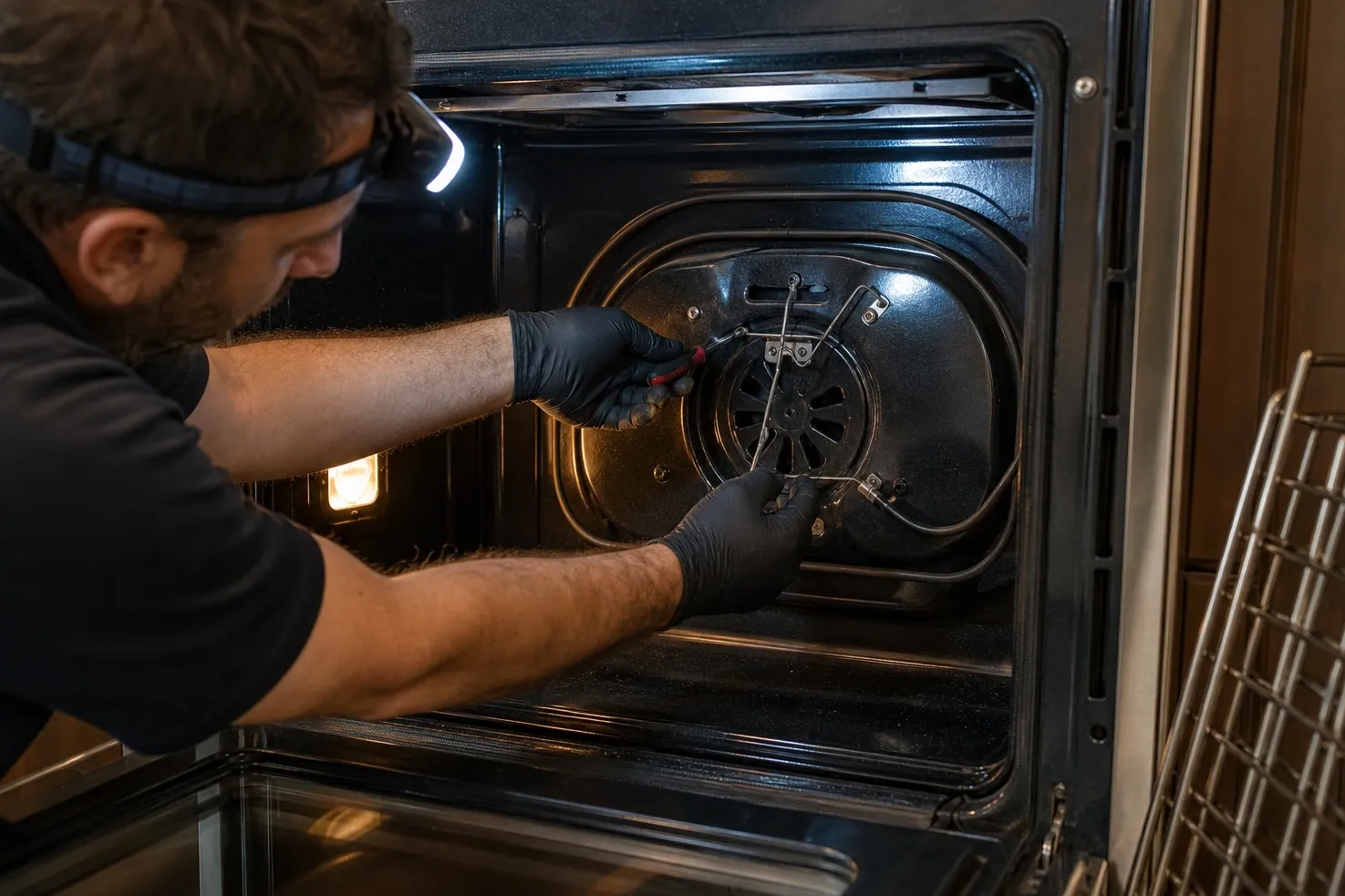
Wolf builds ovens two ways, and the distinction drives the repair. A built-in wall oven is a self-contained electric appliance — E Series and the newer M Series — with bake and broil elements, a convection fan, a temperature probe and a control board, often installed as a stacked double unit. The oven inside a dual-fuel range shares that electric design, while an all-gas range oven heats with a gas burner and a glow-bar igniter instead. Knowing which you have tells us immediately whether a no-heat call points to an element and probe or to an igniter and gas valve. If your oven simply will not get hot, start with our Wolf oven not-heating guide; if it cooks but unevenly, the cause is usually elsewhere.
Most Wolf oven complaints are about accuracy rather than total failure. An oven that reads 350 but bakes like 325 usually has a temperature probe that has drifted, and many Wolf controls allow a calibration offset before any part is replaced. When the cavity genuinely cannot reach temperature, a bake element that has lost continuity or a broil element burned through at one end is the typical cause — both are bounded OEM-part swaps. Uneven browning instead points at the convection system: a fan motor slowing with age circulates less hot air, leaving the back of a sheet pan darker than the front. We test the elements for continuity, read the probe against a calibrated thermometer, and check fan rotation before quoting, so you pay for the part that is actually wrong. Panel F-codes are read against the model service data, never guessed.
A large share of the wall ovens we service are stacked double units built into Peninsula and Silicon Valley kitchens — Burlingame, San Carlos, Los Altos and the estate kitchens of Atherton and Woodside — where replacing a flush built-in means disturbing the surrounding cabinetry. That is exactly why a targeted repair beats replacement on these: a door hinge, a gasket, an element or a control board restores the oven without a cabinetry project. We work cleanly around custom panels, protect the floor, and verify the oven holds its setpoint and the door seals tight before we call it done. When a control board on a discontinued model is genuinely unavailable we say so plainly; the repair-or-replace guide and the cost guide lay out how we weigh it.
These checks help pin down whether your Wolf oven needs calibration, an element or a sensor — and they keep you well clear of live wiring and the gas valve, which stay with a technician.
Put an oven thermometer on the center rack, set 350°F, and let it fully preheat. A reading 25 degrees or more off usually means a calibration offset or a probe — note the gap for the technician.
With the oven on a convection setting, confirm you can hear the rear fan running. A silent or rattling fan often explains uneven browning.
When the oven is cool, feel near the closed door for escaping heat and check the gasket for flat or torn spots and the door for sag — both let heat leak out.
Record the model and serial on the door frame or behind a drawer, plus any F-code on the display, so we bring the right element, probe or board.
If the door stays locked after a self-clean cycle, let the oven cool fully; if it still will not release, leave the lock motor and thermal fuse to a technician rather than prying it.
Anything beyond these checks is a job for a technician. Call (650) 484-4687 with your model and serial and we will confirm parts and the soonest window.
Yes. We repair Wolf E Series and M Series built-in wall ovens, including stacked double units, as well as the convection oven inside a dual-fuel range and the gas oven in an all-gas range. Each is diagnosed on its own terms — electric ovens around elements and probes, gas ovens around the igniter and valve.
The two usual causes are a temperature probe that has drifted, which is often correctable with a calibration offset, or a bake element that has lost continuity and can no longer heat fully. We measure the actual cavity temperature against the setpoint and test the element before deciding, rather than replacing parts on a guess.
Uneven browning usually points to the convection system — a fan motor that has slowed with age circulates less hot air, leaving one part of the cavity hotter. A partly failed broil element or a warped rack can contribute too. We check fan rotation and element performance, then correct the specific cause.
Often, yes. Many Wolf ovens let us enter a calibration offset so the displayed temperature matches the real cavity temperature, which fixes a small, consistent error without any parts. If the gap is large or erratic, that points to the probe or an element instead, and we test to tell the difference.
First let the oven cool completely, since the door stays locked until it drops below a safe temperature. If it still will not release, the cause is usually the door-lock motor, a blown thermal fuse or the control, all of which we can repair. Do not pry the door, which can damage the latch and the surround.
Usually it is, especially for a built-in double oven flush with cabinetry, where replacement also means a cabinetry job. An element, probe, hinge, gasket or board is a fraction of replacement cost. We give an honest read when a part is genuinely unavailable on an older model, but most Wolf ovens are well worth fixing.
Independent service disclaimer. Wolf and Sub-Zero are registered trademarks of their respective owners. Sub-Zero, Wolf and Viking Appliance Services is an independent repair company and is not affiliated with, authorized by, or a factory service center for Wolf or Sub-Zero Group, Inc. We install genuine OEM parts and follow manufacturer service specifications.