Sub-Zero 600 Series error codes: what each one is telling you
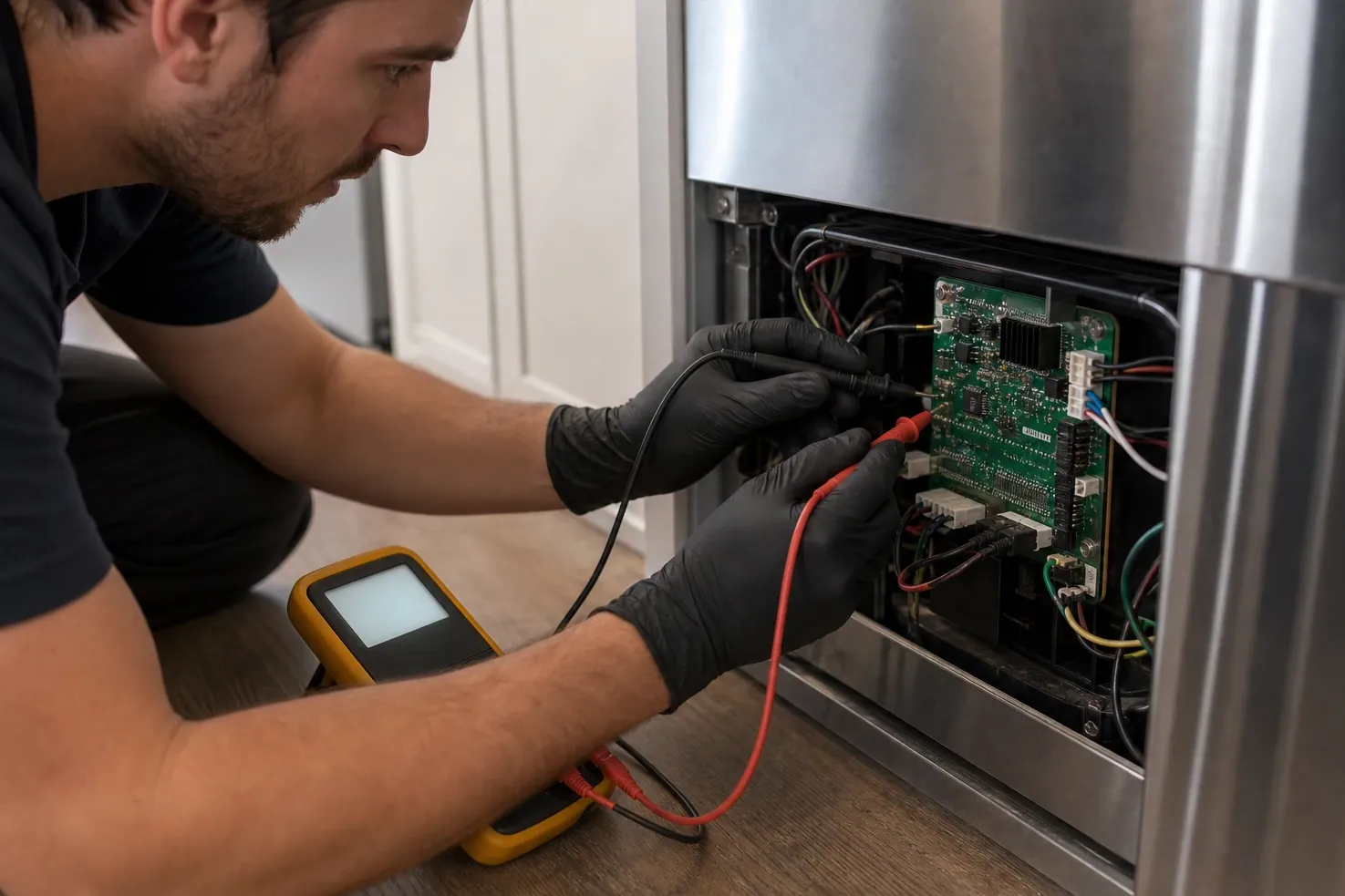
A Sub-Zero 600 Series error code is a diagnostic pointer, not a verdict. Each "EC" number flags one subsystem — sensors (EC 05–08), defrost (EC 20–24), ice maker (EC 30), compressor/sealed system (EC 40), or excessive run time (EC 50, the most common). It narrows the fault; a technician confirms the cause.
This matters because the 600 was the first Sub-Zero generation that could speak up at all. The mechanical 500s before it ran on a dial and told you nothing — you diagnosed by feel. Built from 1996 to 2009, the 600 added a control board, thermistors, magnetic door switches and adaptive defrost, and with them the ability to surface a code on the display. We see plenty of these units still working in Los Altos, Atherton and Saratoga kitchens, so it pays to know what the panel is actually saying.
What changed when the 600 went electronic
The leap from the 500 to the 600 was a control-system leap. Where a 500 read its temperatures off a mechanical thermostat and a turn-dial scale, the 600 reads them off thermistors feeding a control board, watches the doors through magnetic reed switches, and decides when to defrost adaptively rather than on a fixed clock. All of that runs on R-134a refrigerant.
The practical upshot for an owner is that the box now keeps a running log of how it is behaving, and when a reading falls outside its expected window it raises an error code. That is genuinely useful — it tells us which corner of the machine to open first instead of starting from scratch. But a code is only as good as the read behind it. A thermistor that has drifted, or a board that misreports, can throw a code that points at a healthy part, which is why we treat the on-screen number as a strong lead and never as the final word. If you have already pulled your model and serial, our model-number guide shows where the 600's rating plate hides so we arrive with the right revision of parts.
The code table, in plain English
Here is the 600 Series code family laid out the way we actually use it on a call. Codes vary slightly between the 600, 600-2 and 600-3 generations, and a technician reads the full set in diagnostic mode — so use this as a map, not a repair manual. To see the complete on-board sequence yourself, our service-mode walkthrough covers how a 600 enters diagnostics.
| Code | What it flags | Likely cause | First check / when to call |
|---|---|---|---|
| EC 05–08 | Thermistor / temperature-sensor fault | A sensor reading out of range or open/shorted | Not a DIY fix — a sensor or its wiring needs testing against a calibrated probe |
| EC 20 / 21 / 24 | Defrost fault | Defrost heater, drain or defrost thermostat; evaporator iced over | Watch for frost buildup or water under the box; book a technician |
| EC 30 | Ice maker fault | Ice-maker module, water valve or supply line | Confirm the water line is open and the maker is switched on; then call |
| EC 40 | Compressor / sealed-system fault | Compressor, relay, or a refrigerant/sealed-system problem | Professional-only — see our sealed-system page |
| EC 50 | Excessive refrigerator-compressor run time (most common) | Tired door gasket, dirty condenser, or a sealed-system fault | Check the door seal and clean the condenser first; call if it persists |
A full hub of per-code explanations lives at our error-codes reference if you want to read deeper on the exact number your panel is showing.
EC 50 and the VACUUM CONDENSER alert: read these right
Two messages cause more confusion than the rest combined, and they are cousins. EC 50 means the fresh-food compressor has been running far longer than it should to hold temperature. The 600 is not broken in the dramatic sense — it is working too hard, and it is telling you so. The three usual culprits, in order, are a door gasket that has hardened and no longer seals after fifteen-plus years, a condenser coil choked with dust (worse in homes with pets or near the Peninsula fog), or an actual sealed-system fault. We start at the cheap, common end and earn our way to the expensive one, not the other way around.
The VACUUM CONDENSER (or SERVICE) alert is the same idea wearing a different label. It is a performance warning the board raises when it sees too much compressor runtime — driven by a dirty condenser, a weak door seal, or a hot kitchen on a heat-spike afternoon. Crucially, it is not a fixed-interval timer counting down to a service date, the way a car's oil light sometimes is. The fix is to verify the box temperatures, clean the condenser coil, confirm the door seal pulls flush, and power-cycle. Sub-Zero recommends cleaning that coil every twelve months — twice a year in a dusty home or one with pets — and on a 600 that single habit heads off most EC 50 calls before they start. When the gasket and the coil are both ruled out and the code stands, that is the point at which it becomes a control-board or sealed-system question, and we test before we replace so you never pay for a guess.
Questions & answers
My Sub-Zero 600 shows EC 50 — is the compressor dying?
Usually not. EC 50 means the fresh-food compressor is running too long to hold temperature, and the most common reasons are a tired door gasket or a dirty condenser coil — both inexpensive. A genuine sealed-system or compressor fault is possible but is what we rule in last, after the cheap causes are cleared.
Does the VACUUM CONDENSER message mean I have to service the unit on a schedule?
No. It is a performance alert, not a countdown timer. The board raises it when it sees excessive compressor runtime, typically from a dirty condenser, a weak door seal, or a hot kitchen. Verify temperatures, clean the coil, check the door seal and power-cycle. If it returns after that, it is worth a technician's diagnosis.
The older 500 Series next door has no codes — why?
Because the 500 is mechanical. It runs on a dial thermostat with no control board, so it has no way to display a code — you diagnose it by symptom. The 600 was Sub-Zero's first electronic generation, which is exactly what gave it thermistors, a board and the error-code system. Our 500 Series guide covers how that older era is serviced.
More Bay Area repair guides
- Owner decision · 4 minSub-Zero Alternatives: How Thermador, Miele and Liebherr Compare in a Bay Area KitchenSub-Zero vs Thermador, Miele, Liebherr, Monogram, Dacor and True: a repair bench's read on every real Sub-Zero alternative, and when keeping yours wins.Read the guide →
- Undercounter & Drawer Units · 5 minSub-Zero Undercounter & Drawer Units: An Owner's Repair GuideHow Sub-Zero undercounter, beverage, and drawer units fail in island and bar installs, what repairs cost in the Bay Area, and when to repair or replace.Read the guide →
- Wolf E Series Case Story · 5 minThe Wolf E Series Oven Everyone Blamed on the BoardA Noe Valley Wolf E series wall oven died on bake while the broiler kept working. Everyone blamed the relay board. The meter blamed a $438 bake element.Read the guide →