Sub-Zero wine cooler repair in Burlingame: why a column drifts warm
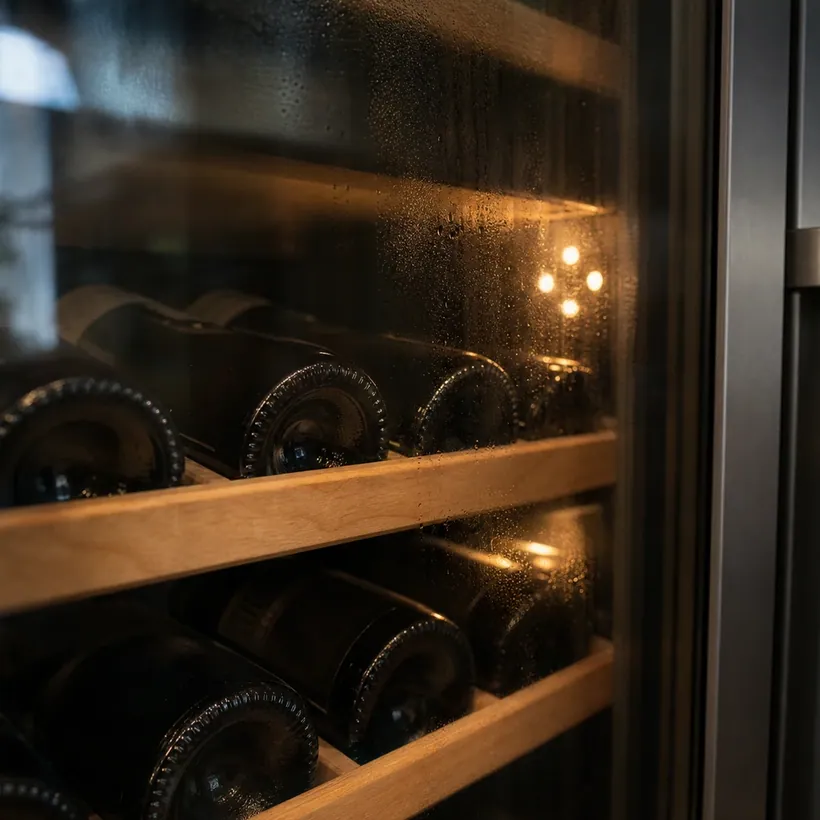
If you keep a serious bottle count in a Burlingame, Hillsborough or Woodside home, the appliance you most want to trust is the one you check least: the Sub-Zero wine column quietly holding 55°F in the corner of the kitchen or down in a converted cellar. Sub-Zero builds genuine built-in wine storage — integrated columns and undercounter units engineered to keep a reds zone and a whites zone honest at the same time — and when one drifts, the worry is rarely the cabinet. It is what is inside it.
From our Chapin Avenue shop we see these calls cluster among Peninsula estate kitchens, where a single column can be holding a five-figure collection and a two-degree drift over a warm inland afternoon is enough to make an owner reach for the phone.
Dual-zone drift: the most common complaint
A dual-zone Sub-Zero wine unit runs two independently controlled compartments off a shared sealed system, balanced by a damper and a pair of temperature sensors. When the lower reds zone holds but the upper whites zone creeps warm — or the two slowly converge on a single temperature — the usual cause is a failing zone sensor (a thermistor reading a few degrees off) or a damper that no longer modulates cleanly. The collection is fine; the control loop has simply lost its reference. We read both sensors against a calibrated probe before touching anything, because replacing a healthy board to chase a $40 thermistor is exactly the guess we refuse to make.
Airflow, the condenser, and the warm-afternoon symptom
A wine column is air-cooled like any built-in. Behind the grille sits a condenser coil that has to shed heat into the room, and in a Peninsula kitchen that pulls cooking grease or sits near the bayfront damp, that coil cakes over a couple of seasons. A loaded coil shows up first as a unit that holds set point on a cool morning but drifts up on the first hot afternoon of an inland heat spike, when the room air it depends on is already warm. The evaporator fan that circulates cold air through the cabinet is the other airflow suspect — a tired fan leaves the top shelves warmer than the bottom even when the compressor is working perfectly.
Seals, glass and the quiet enemy: vibration
Wine storage lives or dies on a stable, dark, still environment. A door gasket that has gone stiff or a UV-treated glass door seal that no longer pulls flush lets warm, light kitchen air leak in at the perimeter — you will often see it as condensation or a faint frost line along one edge. And then there is vibration. A compressor mount that has aged, or a fan bearing starting to growl, transmits a low buzz into the racks that, over months, disturbs the sediment in older bottles and undoes the very thing the cabinet exists to protect. A unit that has grown audibly louder is worth a look before it costs you a vintage.
Repair or replace, honestly
The reassuring news for Burlingame collectors: most wine-cooler faults are bounded, OEM-part repairs — a sensor, a damper motor, an evaporator fan, a gasket, a control board. Those are worth fixing in a built-in column that is otherwise sound, especially the integrated models matched to a cabinetry surround you would not want to disturb. We weigh the repair against the unit's age and the cost of the part, tell you plainly when a 15-year-old undercounter unit is near the end of its sealed-system life, and never pad the bill. Our $89 service call is waived when the repair goes ahead, and we work by phone or online booking — no forms, no email tag while your collection sits a few degrees too warm. For everything we cover on these units, see our Sub-Zero wine refrigerator repair page.
Questions & answers
Why is only one zone of my Sub-Zero wine cooler warm?
On a dual-zone unit each compartment has its own sensor and shares a damper. One warm zone usually points to a drifting thermistor or a damper that is not modulating — both bounded repairs, not a failed cabinet. We verify with a calibrated probe before replacing anything.
Will a few degrees of drift ruin my wine?
A short excursion rarely harms a collection, but sustained warmth and temperature swings age wine faster and can push corks. If your column has been drifting for weeks, it is worth diagnosing promptly rather than waiting for it to fail outright.
Does Sub-Zero really make wine storage, or is that Wolf?
Sub-Zero makes the built-in wine columns and undercounter wine storage. Wolf is the cooking side of the family — ranges, ovens and cooktops. We service both, plus Cove dishwashers, across the Peninsula and the wider Bay Area.
More Bay Area repair guides
- Owner decision · 4 minSub-Zero Alternatives: How Thermador, Miele and Liebherr Compare in a Bay Area KitchenSub-Zero vs Thermador, Miele, Liebherr, Monogram, Dacor and True: a repair bench's read on every real Sub-Zero alternative, and when keeping yours wins.Read the guide →
- Undercounter & Drawer Units · 5 minSub-Zero Undercounter & Drawer Units: An Owner's Repair GuideHow Sub-Zero undercounter, beverage, and drawer units fail in island and bar installs, what repairs cost in the Bay Area, and when to repair or replace.Read the guide →
- Wolf E Series Case Story · 5 minThe Wolf E Series Oven Everyone Blamed on the BoardA Noe Valley Wolf E series wall oven died on bake while the broiler kept working. Everyone blamed the relay board. The meter blamed a $438 bake element.Read the guide →