Is a vintage Sub-Zero built-in worth restoring? A Bay Area technician's view
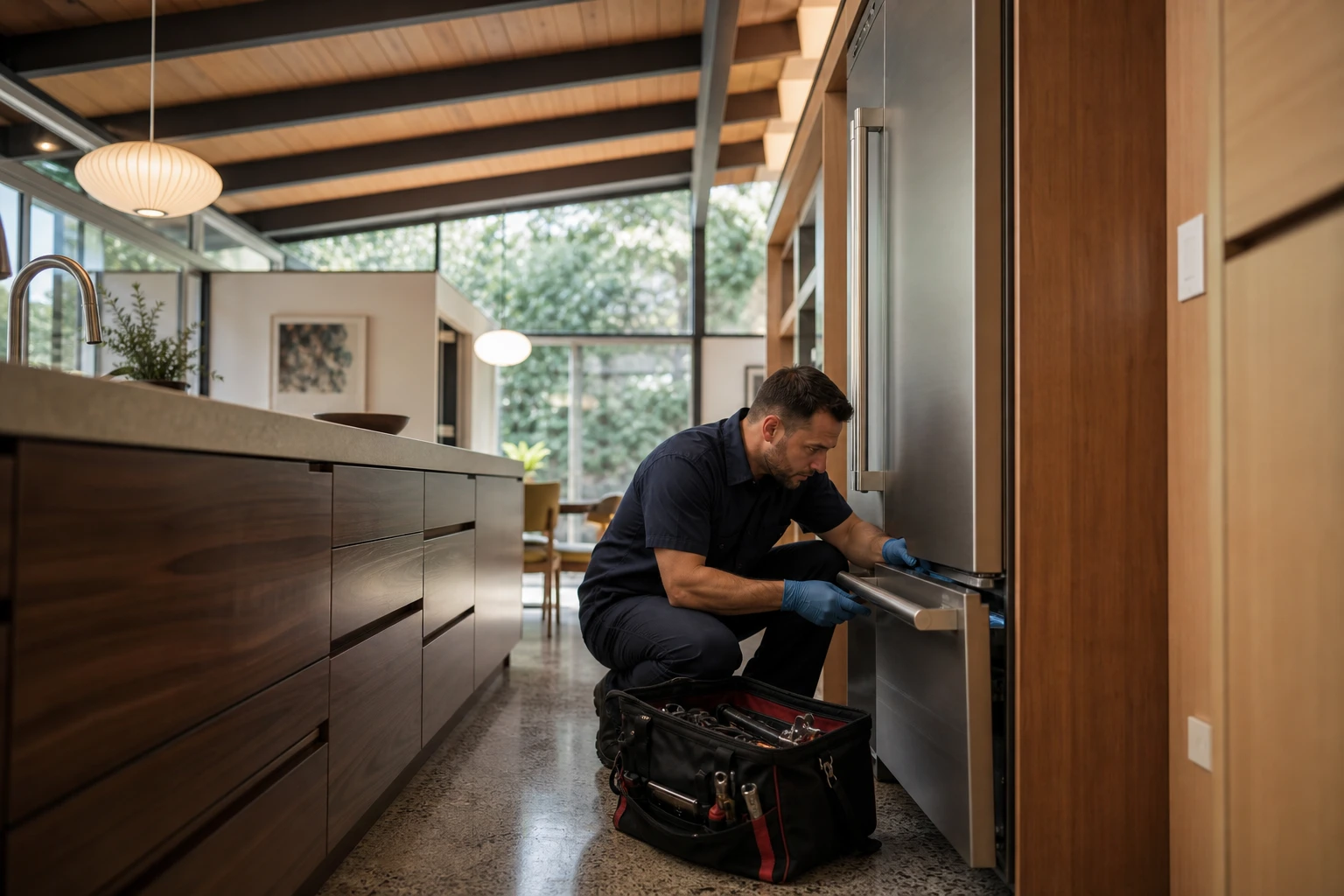
Usually, yes. On a vintage Sub-Zero built-in the steel cabinet, foam insulation and stainless frame far outlast the sealed system, so what fails is almost always a single serviceable part — a gasket, a fan, a thermistor — not the appliance. A targeted repair beats a roughly $13,000–$15,000 replacement.
We run a lot of these calls from our shop on Chapin Avenue, and the heaviest concentration sits in the older valley towns. Los Altos kitchens in particular still hold a remarkable number of 500 and 600 series units from the late 1980s through the 2000s, and the estate homes of Atherton, Hillsborough, Woodside and Saratoga keep long-owned built-ins running well past the age at which a free-standing fridge would have been hauled to the curb.
Why the cabinet outlives the machinery
It helps to think of a built-in Sub-Zero as two separate things bolted together: a cabinet and a cooling system. The cabinet is a welded steel shell wrapped in dense foam insulation behind a stainless frame, dimensioned to drop flush into a run of cabinetry. That part does not really wear out. We open units in mid-century Eichlers and 1990s remodels where the box is dead-square and the insulation is still tight after two decades of service.
What ages is the cooling system and its moving wear parts — the compressor, the evaporator and condenser fan motors, the defrost components, and above all the door gaskets, which harden and tear after roughly twenty years and quietly become the number-one fault we find. None of that is the cabinet. Each of those is a bounded, replaceable component, and Sub-Zero has historically stocked OEM parts for these generations well over fifteen to twenty years after a model left production. That combination — a permanent cabinet plus a repairable machine plus available parts — is exactly why a vintage built-in is so often worth keeping. Before any of it, find the model and serial on the rating plate behind the upper grille; our model-number guide shows where to look so we can confirm parts for your exact build.
The dual-compartment advantage in older estate kitchens
There is a structural reason these units age gracefully that owners rarely know about. The combination models — the 511, 532, 542, 550, 561 and 590 in the 500 series, and their 600-series successors — are built over-and-under, fresh food on top and freezer below, and most of them carry two compressors and two evaporators, one dedicated to each compartment. The 532 popularized that dual design. (The single-compartment 501R all-refrigerator and 501F all-freezer run one compressor each.)
That independence changes the repair math in a long-owned home. When one side of a dual-system unit fails — say the freezer warms while the fresh-food side holds perfectly — you are looking at one sealed circuit needing attention, not a dead appliance. We see this constantly in Los Altos and the Atherton estates: a thirty-year-old built-in where half the machine is flawless and the other half wants a fan motor or a sealed-system repair. Diagnosing which circuit is at fault, and whether it is a simple part or a deeper sealed-system issue, is the first thing our technician does on site.
When restoring stops making sense
We are an independent shop, not a dealer, so we have no incentive to push a sale — and there are real cases where replacement is the honest call. The deciding factor is almost always the sealed system. A failing original compressor, or a deep refrigerant leak in an evaporator buried in the cabinet wall, is the one repair that approaches a meaningful fraction of replacement cost: industry estimates put major sealed-system and compressor work somewhere in the rough range of $900 to $3,000, against roughly $13,000 to $15,000 to buy and install a new built-in. When a unit needs that level of work and is also showing other end-of-life symptoms, the value tips.
Everything short of that usually favors restoration. Here is how we weigh the common situations we actually find.
How we read the repair-or-replace decision
| What's failing | Typical fix | Our usual verdict |
|---|---|---|
| Hardened or torn door gasket (most common) | OEM gasket replacement | Repair — high value, restores efficiency |
| Condenser or evaporator fan motor | Replace the motor | Repair — bounded, parts available |
| Defrost fault (drain, heater or thermostat) | Replace the failed defrost part | Repair — common and contained |
| One of two sealed circuits warm (dual unit) | Diagnose, often a fan or sealed-system repair | Repair — other circuit is usually fine |
| Original compressor failing | Sealed-system rebuild / compressor | Weigh carefully against age |
| Deep refrigerant leak plus other faults | Major sealed-system work | Replacement may be the honest call |
The takeaway from twenty-plus years of these calls: a vintage Sub-Zero with a great cabinet and one or two failed wear parts is one of the best-value repairs in the kitchen, while a unit whose sealed system is genuinely done has reached the end of an honest life. We tell you which one you have, in plain terms, and our repair-or-replace guide walks through the same logic. There is no email tag and no forms — book online or call (650) 484-4687, and the $89 service call is waived when the repair goes ahead, with a 365-day labor warranty on what we fix. Los Altos and the surrounding valley towns are core territory for this work; you can see our full coverage on the service-areas page.
Questions & answers
How old is too old for a Sub-Zero built-in?
There is no fixed cutoff. Cabinets routinely outlast 25 to 30 years, so age alone rarely decides it — the condition of the sealed system does. A 25-year-old unit needing a gasket and a fan is well worth keeping; one with a dying original compressor and a refrigerant leak is where replacement starts to make sense.
Can you still get parts for a 1990s Sub-Zero?
Usually, yes. Sub-Zero has historically stocked genuine OEM parts for the 500 and 600 series well over fifteen to twenty years after a model was discontinued — gaskets, fan motors, defrost components and control parts among them. Give us your model and serial and we confirm availability for your exact build before the visit.
My older built-in still uses R-12 refrigerant — is that a problem?
Not in itself. R-12 was never banned for use; only new U.S. production and import of it ended (December 31, 1995), so an existing R-12 unit can lawfully keep running. Refrigerant work is professional-only and must be handled by an EPA Section 608 certified technician, but a sound R-12 built-in does not have to be retired or converted just because of its refrigerant.
More Bay Area repair guides
- Owner decision · 4 minSub-Zero Alternatives: How Thermador, Miele and Liebherr Compare in a Bay Area KitchenSub-Zero vs Thermador, Miele, Liebherr, Monogram, Dacor and True: a repair bench's read on every real Sub-Zero alternative, and when keeping yours wins.Read the guide →
- Undercounter & Drawer Units · 5 minSub-Zero Undercounter & Drawer Units: An Owner's Repair GuideHow Sub-Zero undercounter, beverage, and drawer units fail in island and bar installs, what repairs cost in the Bay Area, and when to repair or replace.Read the guide →
- Wolf E Series Case Story · 5 minThe Wolf E Series Oven Everyone Blamed on the BoardA Noe Valley Wolf E series wall oven died on bake while the broiler kept working. Everyone blamed the relay board. The meter blamed a $438 bake element.Read the guide →