Sub-Zero maintenance guide: condenser cleaning, filters and annual service
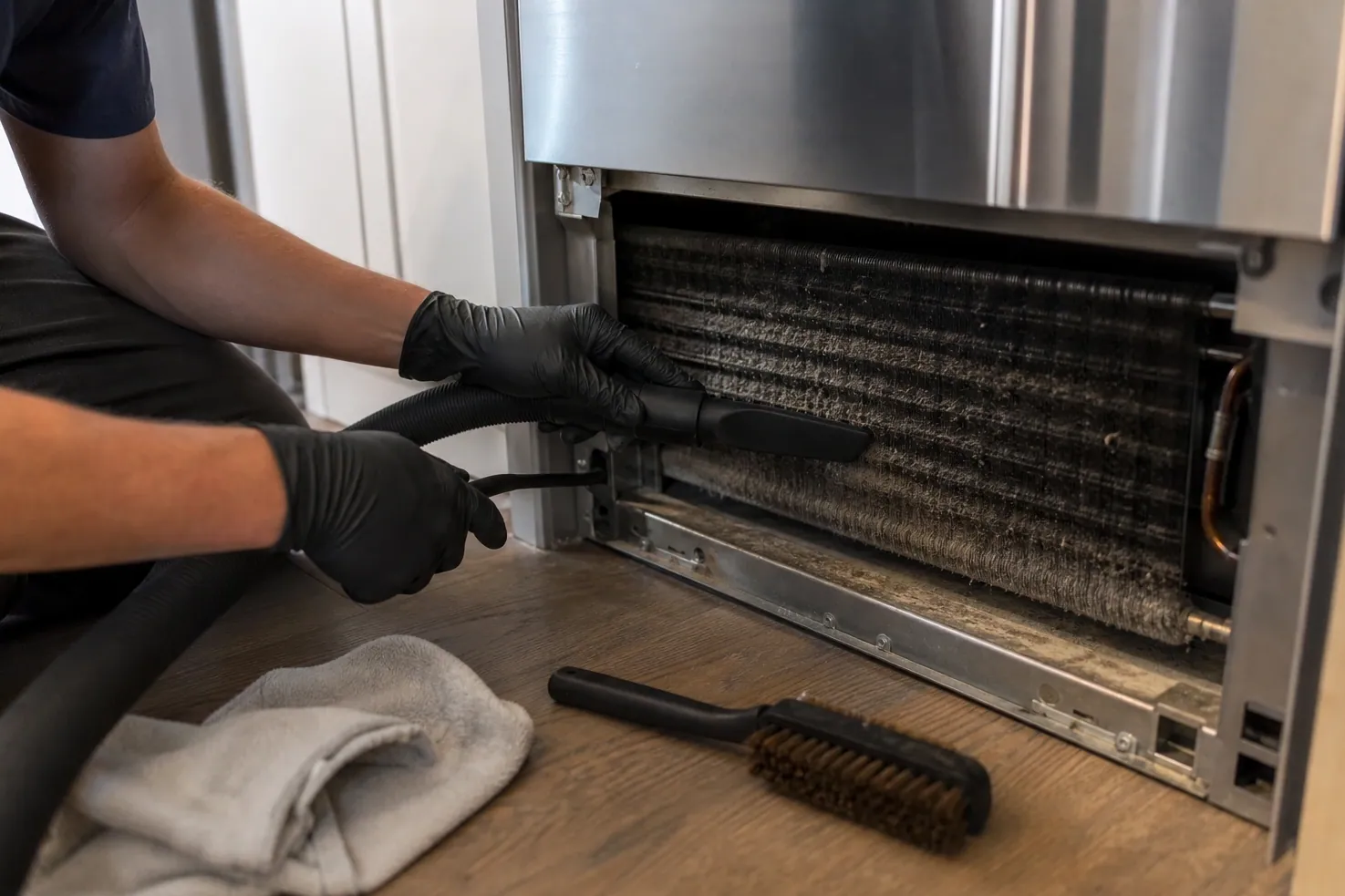
Sub-Zero maintenance comes down to one habit above all others: vacuum the condenser every six to twelve months. Around that, change the water filter about every six months, replace the air filter on schedule, wipe and test the door gaskets, keep the unit level, and have a technician do a once-over every year or two. Done consistently, this prevents most service calls.
That is not a sales pitch — it is the pattern behind nearly every avoidable call we run from our Burlingame base. A built-in Sub-Zero is engineered to last decades, but it hides its hardest-working part behind a grille where dust quietly accumulates, and on the Peninsula the fog-borne grit and pet hair make that worse. Here is the maintenance that actually matters, how to do the one task that counts most, and a simple calendar to keep it on track.
Why a built-in needs more attention than a plug-in fridge
A freestanding refrigerator pushes its condenser heat out the back into open air. A built-in Sub-Zero cannot — it is sealed into cabinetry, so it breathes through a grille at the top or toe-kick and sheds its heat through a condenser coil tucked behind that grille. When the coil mats over with dust, the unit cannot reject heat efficiently, the compressor runs longer and hotter to hold temperature, and you eventually see a warm cabinet, higher energy use, or the EC 50 over-run warning on electronic models.
Two things make this worse in Bay Area kitchens. Sub-Zero's dual-refrigeration design runs two sealed systems, so there is simply more cooling hardware working and more coil to keep clean. And Peninsula homes — especially near the coast and the fog line — collect a fine grit that, combined with pet hair, blankets a condenser faster than most owners expect. We cover that local wrinkle in detail in our Peninsula fog and condenser guide. The good news: the fix is almost entirely preventive, and most of it you can do yourself.
Clean the condenser — the task that prevents the most calls
If you do only one thing on this page, clean the condenser. Sub-Zero recommends it at least every twelve months, and we suggest every six in a home with pets or near the fog. It takes about fifteen minutes and heads off the single most common reason a built-in warms up or overworks.
- Cut the power. Unplug the unit or switch off its breaker so the compressor and fan cannot start while your hands are near them.
- Open the grille. The condenser sits behind the grille at the top of a built-in column (or the lower toe-kick on some models). The grille usually lifts or unclips; your model and serial are often on the plate right behind it — our model-number guide shows where to look.
- Vacuum the coil. Use a vacuum with a brush attachment plus a soft coil brush to lift the dust mat off the fins. Brush gently along the fins, not across them, so you do not bend them.
- Clear the fan and floor. Wipe the condenser fan blade and the area around the coil; pet hair likes to wrap the fan hub.
- Reinstall and restore power. Clip the grille back, plug in or flip the breaker, and confirm the unit starts and begins to cool.
- Set a reminder. Repeat every six to twelve months — calendar it so it actually happens.
If the cabinet is still warm a few hours after a thorough coil clean, the cause is internal — a fan, a sensor or the sealed system — and it is time for a technician rather than another cleaning.
Water and air filters: what to change and when
Sub-Zero units with an ice maker or dispenser carry a water filter, and many carry an air-purification filter too — both are wear items on a schedule, not lifetime parts. The water filter should be changed roughly every six months, or sooner if the dispenser slows or the ice tastes off; a clogged filter restricts flow and makes the ice maker look broken when it is merely starved. The air filter, where fitted, keeps the interior smelling clean and is typically changed about once a year on Sub-Zero's interval.
These are genuinely owner-serviceable — they twist or slide out and are keyed so they only seat one way. Use genuine Sub-Zero filters; universal cartridges often seal poorly or restrict flow, which can mimic a fault and bring on a service call you did not need. If you change the water filter and the ice maker still underperforms, the inlet valve or the ice module may be the real culprit, which is repair territory rather than maintenance.
Door gaskets, leveling and the drain: the annual once-over
Beyond the condenser and filters, a handful of small checks each year keep the rest of the unit honest. The door gasket is the quiet one: as the rubber hardens over the years it stops sealing, warm air leaks in, and the unit runs longer to compensate — the very over-work pattern a dirty coil causes. Wipe the gasket clean with mild soapy water and run the paper-slip test: close the door on a slip of paper and, if it pulls out with no drag, the seal needs attention.
Two more take a minute each. Confirm the unit is level so the doors self-close and seal under their own weight rather than being left ajar. And on units with a defrost drain, a slow or frozen drain shows up as water pooling under the crispers or ice on the freezer floor — worth flagging to a technician before it spreads. When over-work persists after the gasket and coil are both ruled out, that is the point where it becomes a sealed-system question rather than a maintenance one, and our Sub-Zero repair page covers the work from there.
A simple Sub-Zero maintenance calendar
Maintenance only works when it is scheduled. Here is the cadence we give owners — drop the condenser interval to six months if you have pets or live near the fog.
| Task | How often | Why it matters |
|---|---|---|
| Vacuum the condenser coil | Every 6–12 months | Prevents over-work, a warm cabinet and the EC 50 warning |
| Change the water filter | ~Every 6 months | Keeps water and ice flowing and tasting clean |
| Replace the air filter (if fitted) | ~Every 12 months | Keeps interior air and odors in check |
| Clean & test the door gaskets | Every 6 months | A leaking seal makes the unit run long and warm |
| Check level & door self-close | Annually | Doors that do not self-seal let warm air in |
| Check the defrost drain | Annually | Catches pooling water and freezer-floor ice early |
| Professional once-over | Every 1–2 years | Catches sensor drift and wear before it becomes a breakdown |
The whole owner list adds up to maybe an hour a year. Against a built-in that can cost several thousand dollars to replace, it is the cheapest insurance in the kitchen. If you would rather have it done, book online or call (650) 484-4687 — the $89 service call is waived when a repair goes ahead, with a 365-day labor warranty — and what a visit really costs is laid out plainly in our repair cost guide.
Maintenance terms, defined
- Condenser coil
- The coil behind the grille that sheds the heat pulled out of the cabinet. A dust mat here is the number-one cause of a built-in over-working — and the easiest thing to prevent.
- Dual refrigeration
- Sub-Zero's design of two separate sealed systems, one for the fridge and one for the freezer. It means more cooling hardware — and more coil — to keep clean.
- Door gasket
- The flexible seal around each door. As it hardens it stops sealing, letting warm air in and forcing the unit to run longer; the paper-slip test reveals it.
- Adaptive defrost
- The control logic on electronic Sub-Zeros that decides when to defrost based on use rather than a fixed clock. A blocked drain or failed heater shows up as frost or pooling water.
- Air filter
- A replaceable charcoal-style filter that keeps interior air fresh on units that have one. Change it on Sub-Zero's interval, roughly once a year.
- EC 50
- The over-run warning on electronic Sub-Zero models — the compressor is running longer than it should. A dirty condenser or a tired gasket is the usual, fixable cause.
Questions & answers
How often should I clean my Sub-Zero condenser?
At least once a year, and every six months in a home with pets or near the Peninsula fog. It is the single most important Sub-Zero maintenance task: a clean coil lets the unit reject heat efficiently, while a dust-matted one makes the compressor run long and hot and can trigger the EC 50 warning.
Do Sub-Zero refrigerators need a water filter change?
Yes, on any unit with an ice maker or dispenser — about every six months, or sooner if the dispenser slows or the ice tastes off. Use genuine Sub-Zero filters; universal cartridges often restrict flow and can mimic an ice-maker fault. If a fresh filter does not fix poor ice, the inlet valve or ice module may be the cause.
Can I maintain a Sub-Zero myself, or do I need a technician?
Most of it is owner-friendly: vacuuming the condenser, changing filters, cleaning and testing the gaskets, and checking the level all take simple tools. A professional once-over every year or two is worth it to catch sensor drift and wear early — but the routine prevention that matters most is squarely DIY.
How much does Sub-Zero maintenance cost?
The owner tasks cost almost nothing but your time. A professional maintenance visit starts at our $89 service call, which is waived if a repair is needed and booked. Set against a built-in that can cost several thousand dollars to replace, regular upkeep is the cheapest protection there is — our repair cost guide breaks down the rest.
What happens if I never clean the condenser?
The coil mats with dust, the unit cannot shed heat, and the compressor runs longer and hotter to keep up. You will see higher energy bills, a cabinet that struggles to hold temperature, the EC 50 over-run warning on electronic models, and over the years premature wear on the sealed system — the expensive failure that good maintenance is meant to prevent.
More Bay Area repair guides
- Owner decision · 4 minSub-Zero Alternatives: How Thermador, Miele and Liebherr Compare in a Bay Area KitchenSub-Zero vs Thermador, Miele, Liebherr, Monogram, Dacor and True: a repair bench's read on every real Sub-Zero alternative, and when keeping yours wins.Read the guide →
- Undercounter & Drawer Units · 5 minSub-Zero Undercounter & Drawer Units: An Owner's Repair GuideHow Sub-Zero undercounter, beverage, and drawer units fail in island and bar installs, what repairs cost in the Bay Area, and when to repair or replace.Read the guide →
- Wolf E Series Case Story · 5 minThe Wolf E Series Oven Everyone Blamed on the BoardA Noe Valley Wolf E series wall oven died on bake while the broiler kept working. Everyone blamed the relay board. The meter blamed a $438 bake element.Read the guide →