R-12 to R-134a on an old Sub-Zero: convert, recharge, or replace?
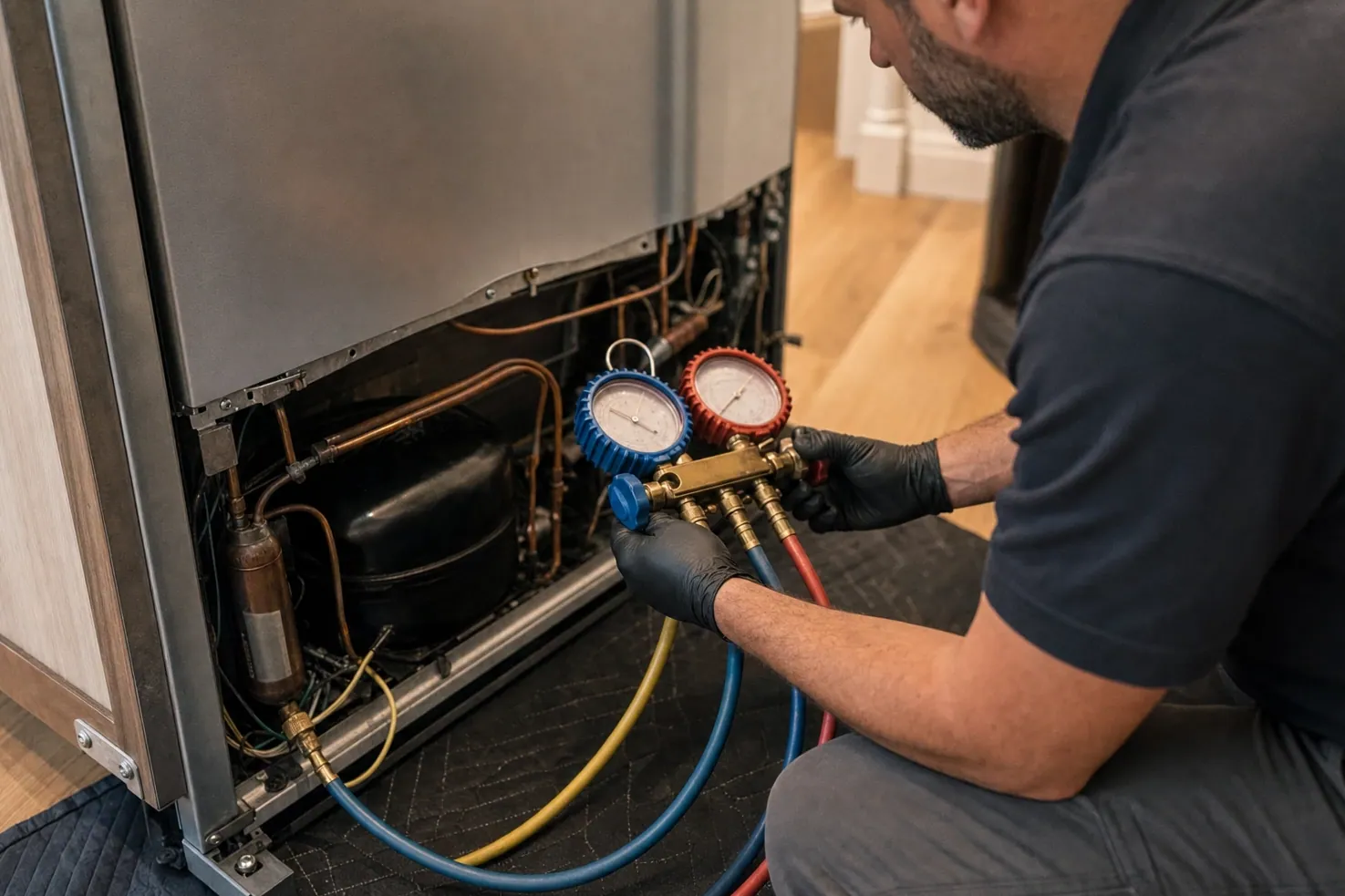
Converting an old Sub-Zero from R-12 to R-134a is a sealed-system rebuild, not a gas swap: a certified technician recovers the R-12, fixes the leak, switches the mineral oil to POE oil, replaces the filter-drier, deep-vacuums, and recharges by weight.
R-12 itself was never outright banned. New U.S. production and import of CFC-12 ended on December 31, 1995 under the Montreal Protocol, but it is still legal to run and service equipment designed for it. So before anyone talks conversion, the first question we ask at our Chapin Avenue shop is whether your unit even needs to leave its original refrigerant behind.
The legal picture, stated plainly
A lot of vintage-Sub-Zero owners — especially in the older estate kitchens we cover in Los Altos, Atherton and Woodside — arrive believing their refrigerant is illegal and the fridge is therefore scrap. It is not. What ended on December 31, 1995 was the manufacture and import of new CFC-12 here in the United States, under Title VI of the Clean Air Act implementing the Montreal Protocol. A Sub-Zero built for R-12 can keep running on R-12 indefinitely and can be lawfully topped up with reclaimed gas.
What the law does control is who touches it and how. Three rules turn refrigerant work into strictly professional territory. First, under Section 608 of the Clean Air Act, refrigerant may never be knowingly vented during service, repair or disposal — it has to be recovered into proper equipment. Second, refrigerant can generally only be sold to certified technicians, so a homeowner cannot lawfully buy R-12 to top off a system. Third, the work requires a technician who holds EPA Section 608 certification for stationary refrigeration (Section 608, not the automotive Section 609 you sometimes hear quoted). Venting carries serious teeth — civil penalties that can reach tens of thousands of dollars per day, per violation. This is why we treat every sealed-system job as recover-first, and why sealed-system work is never a DIY project.
What a real conversion actually involves
When someone says "just put R-134a in it," they are picturing a quick gas swap. The reality is closer to rebuilding the heart of the refrigerator. R-134a will not circulate the mineral oil that an R-12 compressor was charged with, so the lubricant itself has to change — out goes the mineral oil, in goes a POE (polyolester) oil that R-134a can carry through the system. That alone makes it a teardown rather than a recharge.
The honest sequence runs like this: a certified technician recovers the remaining R-12, finds and repairs the actual leak (on these units it is frequently the evaporator coil), changes the lubricant to POE oil, fits a fresh filter-drier sized for the new refrigerant, re-matches the metering, pulls a deep vacuum to dry and clean the system, and only then recharges by weight. We keep the specifics in the van where they belong; what matters for an owner is understanding that a conversion is real labor on a hermetic system, not an afternoon's tinkering. And it does not erase the original fault — if the system is empty, it is empty because something leaked, and that leak still has to be closed first.
The honest performance caveat — and a warning
Here is the part the internet usually skips. R-134a in a system that was engineered for R-12 runs at higher head pressure and delivers lower cooling capacity. In practice that often means a fridge that cools slightly less efficiently and works its compressor a little harder than it did on its original charge. A good conversion can absolutely give you a reliable, code-legal box again — but anyone promising "same or better than new" is not being straight with you. We would rather you know the trade-off going in.
One thing we will never do, and would urge any owner to refuse: hydrocarbon "drop-in" refrigerants marketed for old R-12 systems — propane-based R-290, isobutane R-600a, and the various "12a," "ES-12a" and "DuraCool" blends. These are A3-flammable gases, they are not approved retrofits for a household Sub-Zero, and putting a flammable charge into a fridge designed for a non-flammable one is a genuine fire and liability hazard. Cheap and available is not the same as safe. (For context, R-134a has its own clock too: since January 1, 2021 it can no longer be used in newly manufactured household refrigerators under the HFC phasedown, but it remains perfectly legal to service and retrofit existing units like yours.)
Convert, recharge, or replace — the three honest paths
This is the conversation we actually have at the kitchen counter, and there is no single right answer. It depends on what failed, how scarce the gas is, and how attached you are to the original machine. Reclaimed R-12 keeps the unit on its designed refrigerant for best performance, but the gas is scarce, expensive and certified-only. An R-134a conversion uses cheap, available refrigerant but costs more labor and gives up a little efficiency. And when the compressor itself is already on its way out, neither charge is worth chasing — that is when repair-versus-replace math tips toward a new unit.
It is also worth knowing that many Bay Area shops simply will not field-convert an old Sub-Zero at all. Because these are sealed hermetic systems, a lot of technicians prefer to evacuate and repair with like refrigerant, or to recommend replacement, rather than take on a lubricant-and-metering conversion. We make the call honestly, unit by unit. If you are weighing it on a vintage built-in, our 500 Series repair guide covers how to tell whether your model even left the factory on R-12 or R-134a.
| Path | Best when | Upside | Trade-off |
|---|---|---|---|
| Reclaimed R-12 recharge | System is sound, leak is fixable, you want original performance | Keeps the designed refrigerant; best cooling efficiency | R-12 is scarce, costly and certified-only; leak must still be repaired |
| R-134a conversion | Cabinet and compressor are healthy; R-12 cost or supply is the blocker | Cheap, readily available refrigerant; keeps the original built-in | More labor (oil, drier, metering); slightly higher pressure and lower capacity |
| Replacement | Compressor is already failing or the sealed system has multiple faults | New warranty, current efficiency, no recurring sealed-system risk | Higher upfront cost; industry estimates put a new built-in near $13,000–$15,000 |
For reference, major sealed-system or compressor repair on a built-in runs roughly $900–$3,000 as an industry estimate — a real spread, which is exactly why we diagnose before we quote. Our $89 service call is waived when the repair goes ahead, and you reach us by phone at (650) 484-4687 or by online booking.
Questions & answers
Is R-12 banned, and do I have to convert my old Sub-Zero?
No. R-12 was never outright banned — only new U.S. production and import ended, on December 31, 1995. You can legally keep running an R-12 Sub-Zero and have it recharged with reclaimed R-12 by a certified technician. Converting to R-134a is a choice, usually driven by R-12's cost and scarcity, not a legal requirement.
Can I recharge or convert the refrigerant myself?
No, and not just because it is technical. By law, refrigerant may not be knowingly vented and may generally only be sold to certified technicians, and the work requires someone holding EPA Section 608 certification for stationary refrigeration. Venting can carry civil penalties reaching tens of thousands of dollars per day. It is recover-first, professional-only work — we handle the whole sealed system for you.
Will R-134a cool as well as the original R-12 did?
Usually not quite. R-134a in a system designed for R-12 runs higher head pressure and lower cooling capacity, so it often cools slightly less efficiently and works the compressor a bit harder. A proper conversion still restores reliable, legal cooling — just be wary of anyone promising it will perform the same or better than the original charge.
More Bay Area repair guides
- Owner decision · 4 minSub-Zero Alternatives: How Thermador, Miele and Liebherr Compare in a Bay Area KitchenSub-Zero vs Thermador, Miele, Liebherr, Monogram, Dacor and True: a repair bench's read on every real Sub-Zero alternative, and when keeping yours wins.Read the guide →
- Undercounter & Drawer Units · 5 minSub-Zero Undercounter & Drawer Units: An Owner's Repair GuideHow Sub-Zero undercounter, beverage, and drawer units fail in island and bar installs, what repairs cost in the Bay Area, and when to repair or replace.Read the guide →
- Wolf E Series Case Story · 5 minThe Wolf E Series Oven Everyone Blamed on the BoardA Noe Valley Wolf E series wall oven died on bake while the broiler kept working. Everyone blamed the relay board. The meter blamed a $438 bake element.Read the guide →