Sub-Zero wine storage care guide: built-in columns, dual-zone and humidity
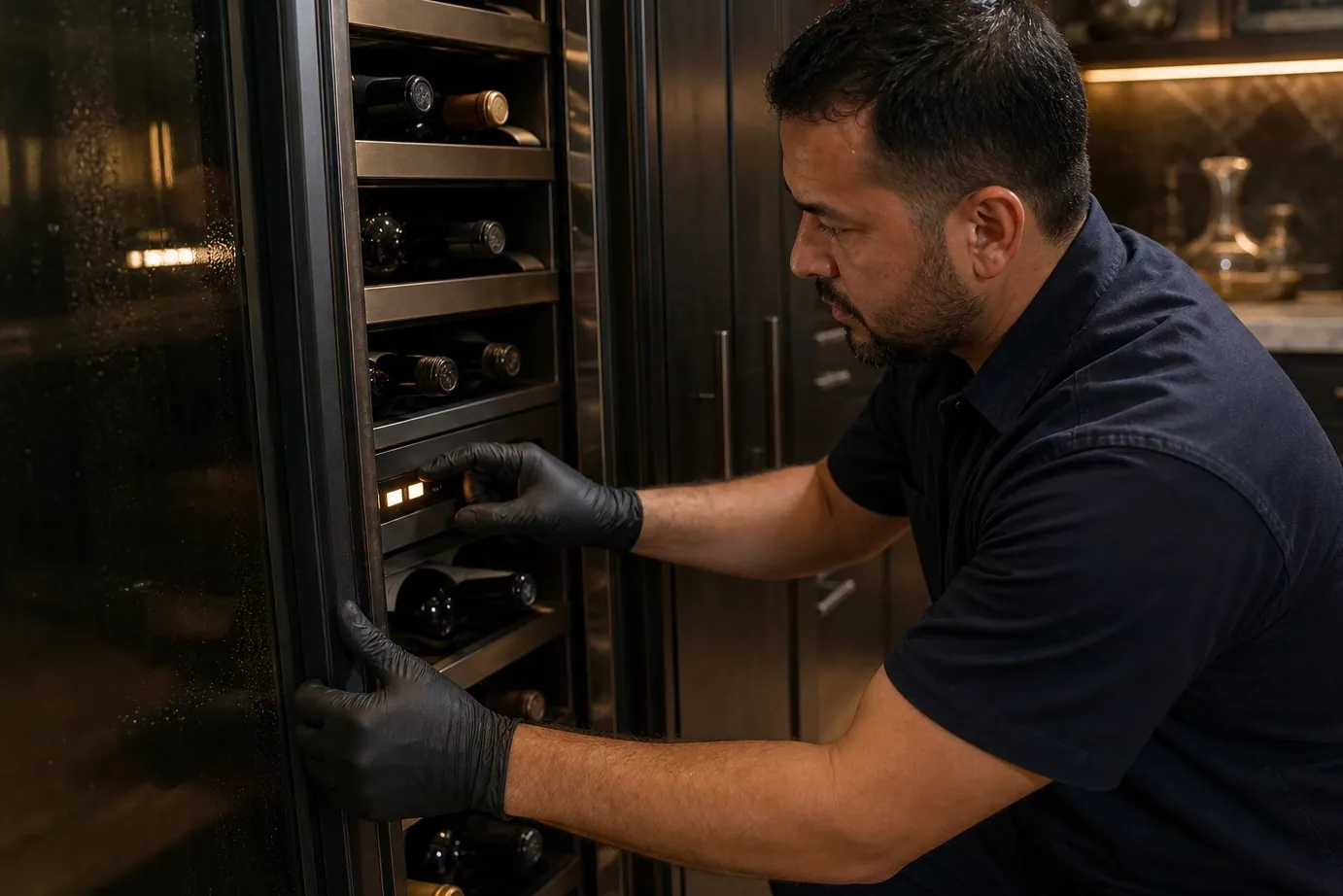
Sub-Zero wine storage is built to hold a stable serving or cellaring temperature with controlled humidity, low vibration and UV-tinted glass. Keep most reds around 55–64°F and whites a touch cooler, store bottles on their sides, clean the condenser twice a year, and limit how often the door opens. Stability beats cold.
That one principle — stability over absolute temperature — is what separates real wine storage from a cold drinks cabinet, and it is the lens this guide uses. Below: how Sub-Zero's columns, undercounter units and combination drawers actually work, the temperatures and humidity that suit different wines, the three quiet things that age a collection, and a short care routine that heads off most service calls.
How Sub-Zero wine storage actually works
Sub-Zero builds wine storage in three formats, and knowing which you own shapes how you care for it. The tall integrated wine columns (the 424, 427 and 430 families) are panel-ready units that drop flush into a run of cabinetry. Undercounter units tuck beneath a worktop, often as a dual-zone drawer of the kitchen. And combination designer units pair wine storage with refrigerator drawers behind one façade, each compartment on its own sealed circuit.
Whatever the format, the storage philosophy is identical. A compressor and condenser reject heat at the grille; an evaporator chills a coil; an evaporator fan moves that air across the bottles; and thermistors feed a control board that holds the set point in a narrow band. On dual-zone units a motorized damper splits one evaporator's cold air between an upper and a lower zone. Three features push these beyond ordinary cooling: UV-tinted glass doors that screen out the light that prematurely ages wine, an active carbon air filter that keeps the interior air fresh, and a cabinet engineered to damp the vibration that disturbs sediment. If a unit ever stops holding its set point, our companion not-cooling troubleshooting guide walks the causes in order, and the wine refrigerator repair page covers the work itself.
The right temperatures and humidity
Serving temperature and storage temperature are not the same thing, and conflating them is the most common mistake we see. For long-term storage, one steady temperature around 55°F suits almost any wine — it is the swings, not the exact figure, that do harm. For serving, you tune the zones to the style you drink. The table below is a practical starting point.
| Wine | Typical serving range | Notes |
|---|---|---|
| Sparkling & Champagne | ~43–50°F | The coolest zone; serve well-chilled |
| Crisp whites & rosé | ~46–54°F | A lower white-zone setting |
| Full-bodied whites | ~50–55°F | A touch warmer than crisp whites |
| Light & medium reds | ~55–62°F | Cellar range, not room temperature |
| Full-bodied reds | ~60–66°F | The warmest typical wine setting |
| Long-term storage (any) | ~55°F, held steady | One stable temperature beats per-type tuning |
Humidity is the other half of the equation. Sub-Zero wine units aim to hold a moderate humidity — broadly in the 50–70% band — so corks stay supple and do not dry out and shrink, which is what lets air in and oxidizes a bottle. You rarely need to manage this by hand; storing bottles on their sides so wine stays in contact with the cork does most of the work, and the unit handles the rest.
Single-zone vs dual-zone — which do you need?
A single-zone unit holds one temperature throughout and is ideal if you store mostly one style or are cellaring for the long term at a steady 55°F. A dual-zone unit holds two independent set points — typically a cooler zone for whites and sparkling and a warmer zone for reds — and earns its keep if you want to pull a bottle from either category at proper serving temperature. Neither is "better"; the right one follows how you actually drink and store.
Humidity, vibration and light: the three quiet killers
Most damage to a stored collection is slow and invisible, and it comes from three directions. The first is dry air: when humidity falls too low, corks shrink, the seal weakens, and oxygen creeps in. Sub-Zero's design targets a moderate humidity to prevent this, which is why a unit running with a failing seal or a frost problem is worth addressing promptly rather than living with.
The second is vibration. Constant low-level shaking keeps sediment in suspension and is thought to disturb the slow chemistry of aging. Sub-Zero damps the compressor and racks for exactly this reason, so a new buzz, hum or rattle is not just an annoyance — it can signal a fan bearing or compressor mount that is transmitting vibration into the bottles. The third is light, especially UV, which breaks down a wine over time; the tinted glass door is your shield, so keep the unit out of direct sunlight and the door closed. Manage those three, hold the temperature steady, and a collection ages the way it should.
A care routine that prevents most service calls
The majority of wine-unit calls we run trace back to maintenance that simply lapsed — usually a condenser that has not been cleaned in years. A short seasonal routine prevents most of them and keeps the unit holding temperature efficiently.
- Clean the condenser coil twice a year — more often with pets in the home. Unplug the unit and gently vacuum the coil behind the grille; this single habit prevents most warm-cabinet calls.
- Wipe and test the door gasket. Clean the seal with mild soapy water and run the paper-slip test — if a slip pulls out with no drag, the gasket needs attention.
- Replace the active carbon air filter on Sub-Zero's recommended interval to keep interior air fresh.
- Confirm the unit is level so the door self-closes and the racks do not transmit extra vibration.
- Avoid overpacking and frequent door openings, and let warm bottles cool gradually rather than forcing the unit to chase a load.
- Verify a shelf temperature once a season with an independent thermometer to catch sensor drift early.
If anything is drifting despite the routine, it is better diagnosed early. There are no forms and no email here — book online or call (650) 484-4687; the $89 service call is waived when the repair goes ahead, with a 365-day labor warranty.
Wine storage terms, defined
- Dual-zone
- A wine unit that holds two independent set points — typically a cooler zone for whites and sparkling and a warmer zone for reds — usually from one evaporator split by a damper.
- Damper
- The motorized flap that apportions cold air between zones on a dual-zone unit, allowing two temperatures from a single cooling source.
- Serving vs cellaring temperature
- Serving temperature is tuned to the wine you are about to drink; cellaring temperature is one steady figure (around 55°F) for long-term storage. Stability matters more than the exact number.
- Relative humidity
- The moisture level inside the cabinet. Sub-Zero wine units target a moderate band (broadly 50–70%) so corks stay supple and do not dry out and admit air.
- UV-tinted glass
- The shaded glass door that screens out ultraviolet light, which breaks wine down over time. It is the reason a wine unit can have a glass door at all without harming the collection.
- Vibration dampening
- Engineering that isolates the compressor and racks so constant shaking does not disturb sediment or the slow chemistry of aging. A new buzz or rattle can signal it is failing.
- Active carbon filter
- A replaceable charcoal filter that keeps interior air fresh and free of odors that could otherwise reach the wine through the cork.
Questions & answers
What temperature should a Sub-Zero wine fridge be set to?
For long-term storage, hold one steady temperature around 55°F for almost any wine. For serving, set reds roughly 55 to 64°F and whites cooler, around 46 to 54°F, with sparkling coolest. The exact figure matters less than keeping it stable — swings age wine faster than a slightly-off but steady temperature.
Do I need a dual-zone wine cooler?
Only if you want to store and serve both whites and reds at their own temperatures. A single-zone unit is perfect for long-term cellaring at a steady 55°F or if you drink mostly one style. Dual-zone earns its keep when you regularly pull both categories at proper serving temperature.
Why does humidity matter for wine storage?
If the air is too dry, corks shrink and the seal weakens, letting oxygen in and oxidizing the wine. Sub-Zero units target a moderate humidity so corks stay supple. Storing bottles on their sides keeps wine against the cork and does much of the work; the unit handles the rest.
Can I store wine long-term in a regular Sub-Zero refrigerator?
It is not ideal. A standard refrigerator runs colder and much drier than wine wants, vibrates more, and opens far more often, all of which age a collection faster. A dedicated wine unit holds a warmer, steadier temperature with controlled humidity and UV protection — that is what proper storage needs.
More Bay Area repair guides
- Owner decision · 4 minSub-Zero Alternatives: How Thermador, Miele and Liebherr Compare in a Bay Area KitchenSub-Zero vs Thermador, Miele, Liebherr, Monogram, Dacor and True: a repair bench's read on every real Sub-Zero alternative, and when keeping yours wins.Read the guide →
- Undercounter & Drawer Units · 5 minSub-Zero Undercounter & Drawer Units: An Owner's Repair GuideHow Sub-Zero undercounter, beverage, and drawer units fail in island and bar installs, what repairs cost in the Bay Area, and when to repair or replace.Read the guide →
- Wolf E Series Case Story · 5 minThe Wolf E Series Oven Everyone Blamed on the BoardA Noe Valley Wolf E series wall oven died on bake while the broiler kept working. Everyone blamed the relay board. The meter blamed a $438 bake element.Read the guide →