Sub-Zero ice maker not making ice — what’s wrong?
A Sub-Zero ice maker that stops making ice is usually caused by a closed or frozen water line, a failed water-inlet valve, a faulty ice-maker module, or a cabinet running too warm. You can safely confirm the water supply is on and the freezer is at temperature; valve and module work needs a technician. $89 service call, waived with repair — call (650) 484-4687.
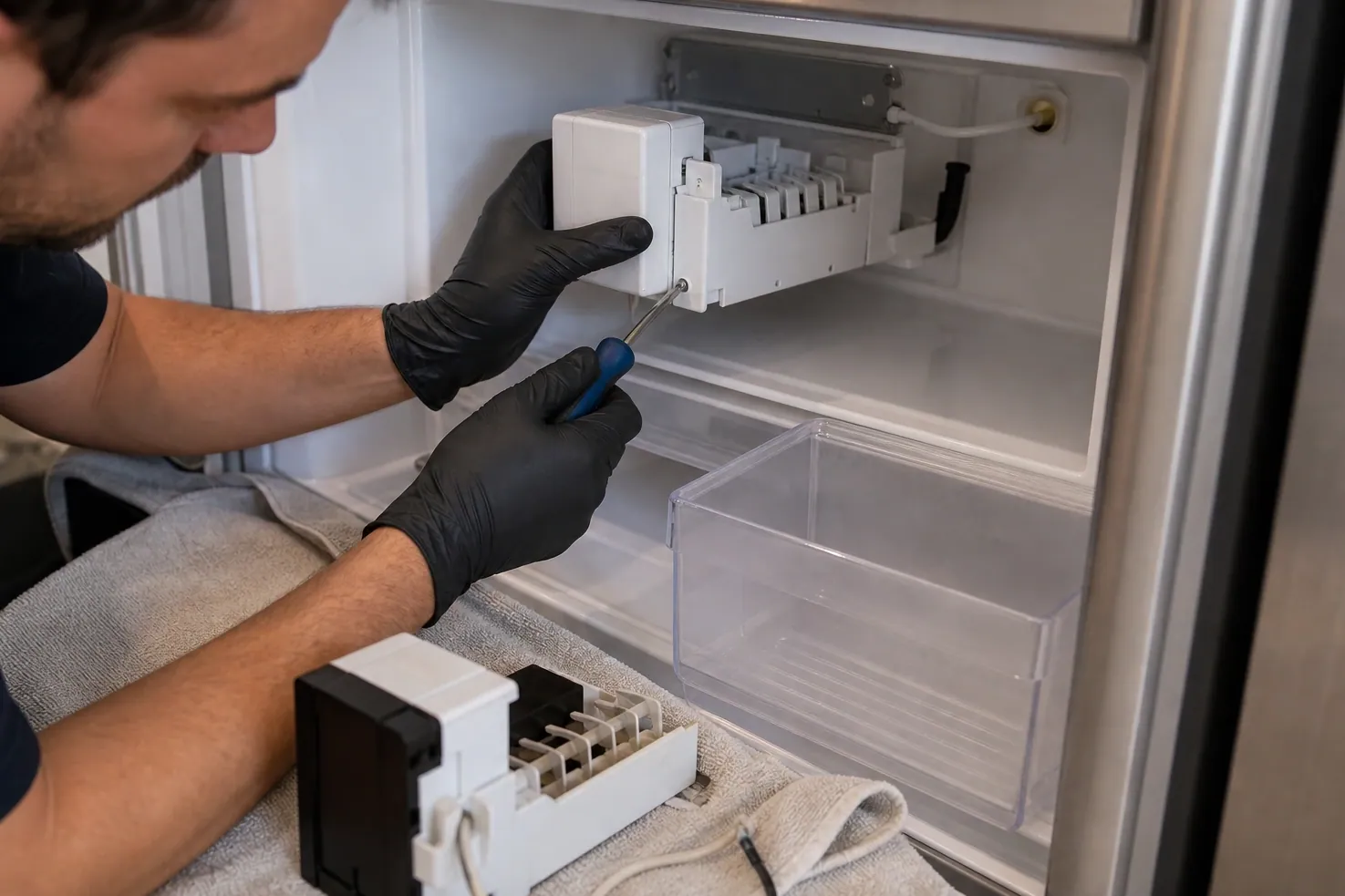
What the symptom usually means
| Symptom | Likely cause | What to do |
|---|---|---|
| No ice at all | Water line off / inlet valve | Confirm supply; diagnostic on valve |
| Low or hollow ice | Partial water flow / pressure | Check line and filter |
| Ice maker not cycling | Module, sensor or thermostat | Diagnostic on ice-maker module |
| Water but no freeze | Freezer too warm | Address cooling first (see not-cooling) |
Why this happens
An ice maker needs three things at once: water flowing in, a compartment cold enough to freeze it, and a working module to cycle and eject the cubes. When ice stops, the job is to find which of those three is missing. The fastest clue is whether there is any water reaching the mold at all — no water points to the supply line or inlet valve, while water that never freezes points to a temperature or module problem.
A frozen fill tube is a classic Sub-Zero ice-maker fault. If the line that feeds the mold develops a slug of ice, no new water can enter and production stops even though the rest of the unit is fine. A failing water-inlet valve causes the same no-ice symptom from the other direction — the valve simply doesn’t open enough to deliver a full fill, which also explains small, hollow or partial cubes.
The ice-maker module itself contains the motor, gears, thermostat and ejector that run the cycle. When the module fails, the arm may stop sweeping, cubes may stick, or the cycle may stall mid-way. Module and valve replacement is technician work with genuine OEM parts; forcing the gears or arm by hand usually makes it worse.
What NOT to do
- Don’t pour hot water into the ice maker to “unfreeze” it.
- Don’t force the ejector arm or gears by hand.
Safe owner checks
- 1 Confirm the water shut-off valve to the unit is fully open.
- 2 Replace the water filter if it is overdue.
- 3 Make sure the freezer is at the correct temperature.
- 4 If there is still no ice, book a diagnostic on the valve and module.
If these checks don't resolve it, the next step is a diagnostic. We confirm the cause on-site; the $89 service call is waived when you book the repair, and labor carries a 365-day labor warranty.
Models and series we service
We service the in-freezer ice makers on built-in BI-series and classic 600/700 models, the dedicated ice-maker drawers, and standalone UC-series under-counter ice machines, which use a different fill and harvest design. Under-counter ice machines also rely on a clean condenser and a working drain pump, so their no-ice symptoms can trace to cooling or drainage rather than the module.
What to expect from a visit
An ice-maker diagnostic confirms water pressure and flow at the valve, checks the fill tube for ice, verifies the freezer or ice-machine temperature, and tests the module’s motor and thermostat. The technician isolates which stage has failed before quoting, replaces the faulty part with a genuine component, and runs a harvest cycle to confirm production before leaving. Most valve, line and module repairs are completed in a single visit.
Frequently asked questions
How long after a repair until I get ice?
A working ice maker typically produces its first full batch within a few hours once water flow and freezer temperature are correct. We run a harvest cycle on-site to confirm the unit is cycling and ejecting cubes before we leave, so you don’t have to wait overnight to know the repair worked.
Why is my Sub-Zero making small or hollow ice cubes?
Small, hollow or partial cubes almost always mean the mold isn’t getting a full fill of water. The usual causes are a partly closed supply valve, low household water pressure, an overdue water filter restricting flow, or a water-inlet valve that no longer opens fully. Check the filter and supply first; if cubes stay undersized, the inlet valve likely needs replacing.
My ice maker has water but the ice won’t freeze — what’s wrong?
If water reaches the mold but never turns to ice, the problem is temperature, not water. The freezer or ice compartment is running too warm, which is a cooling fault rather than an ice-maker fault. Address the cooling issue first — see our not-cooling guide — because no ice maker can keep up if the compartment isn’t cold enough.
Can I just replace the whole ice maker myself?
We don’t recommend it. Sub-Zero ice makers tie into the water-inlet valve, fill tube, sensors and control, and a part-swap that skips the real cause often fails again quickly. A proper diagnostic isolates whether it’s the valve, line, module or temperature, so you replace only what failed — backed by genuine OEM parts and a 365-day labor warranty.
How often should the water filter be changed to keep ice flowing?
Most Sub-Zero owners change the filter roughly every six to twelve months depending on water quality and use. An overdue filter restricts flow, which shows up as slow production and small cubes before it stops ice entirely. If your ice slowed down gradually rather than stopping suddenly, an old filter is one of the first things to rule out.
Do you repair standalone under-counter ice machines too?
Yes. We service Sub-Zero UC-series under-counter ice machines as well as in-freezer ice makers. Standalone units add a condenser and a drain pump to the picture, so their no-ice symptoms can trace to cooling or drainage rather than the module. We diagnose the specific design in your kitchen and quote before any work, with the $89 service call waived on repair.