Sub-Zero freezer not freezing — what’s wrong?
A Sub-Zero freezer that won’t freeze is most often caused by a dust-clogged condenser, a failing freezer evaporator fan, a defrost-system fault that has iced over the coil, or a sealed-system problem. You can safely vacuum the condenser and confirm the door seals and isn’t overpacked; fan, defrost and refrigerant work needs a technician. Same-day service across the Bay Area; the $89 service call is waived when you book the repair — call (650) 484-4687.
What the symptom usually means
| Symptom | Likely cause | What to do |
|---|---|---|
| Freezer warm, fridge OK | Freezer evaporator fan or defrost | Diagnostic — freezer fan & defrost |
| Both compartments warm | Condenser, compressor or sealed system | Vacuum condenser; book a tech |
| Heavy frost on back wall | Defrost heater / sensor failure | Diagnostic — defrost components |
| Runs but never fully freezes | Evaporator fan or sealed system | Diagnostic — airflow & charge |
Why this happens
Most Sub-Zero built-ins run two separate sealed systems, so the freezer can drift warm while the fresh-food side stays cold — and that is a useful clue. When only the freezer is failing, the fault usually sits in the freezer’s own evaporator fan, defrost heater or sensor rather than in a shared component. When both compartments warm together, attention shifts to the condenser, the compressor or a refrigerant charge problem that affects the whole unit.
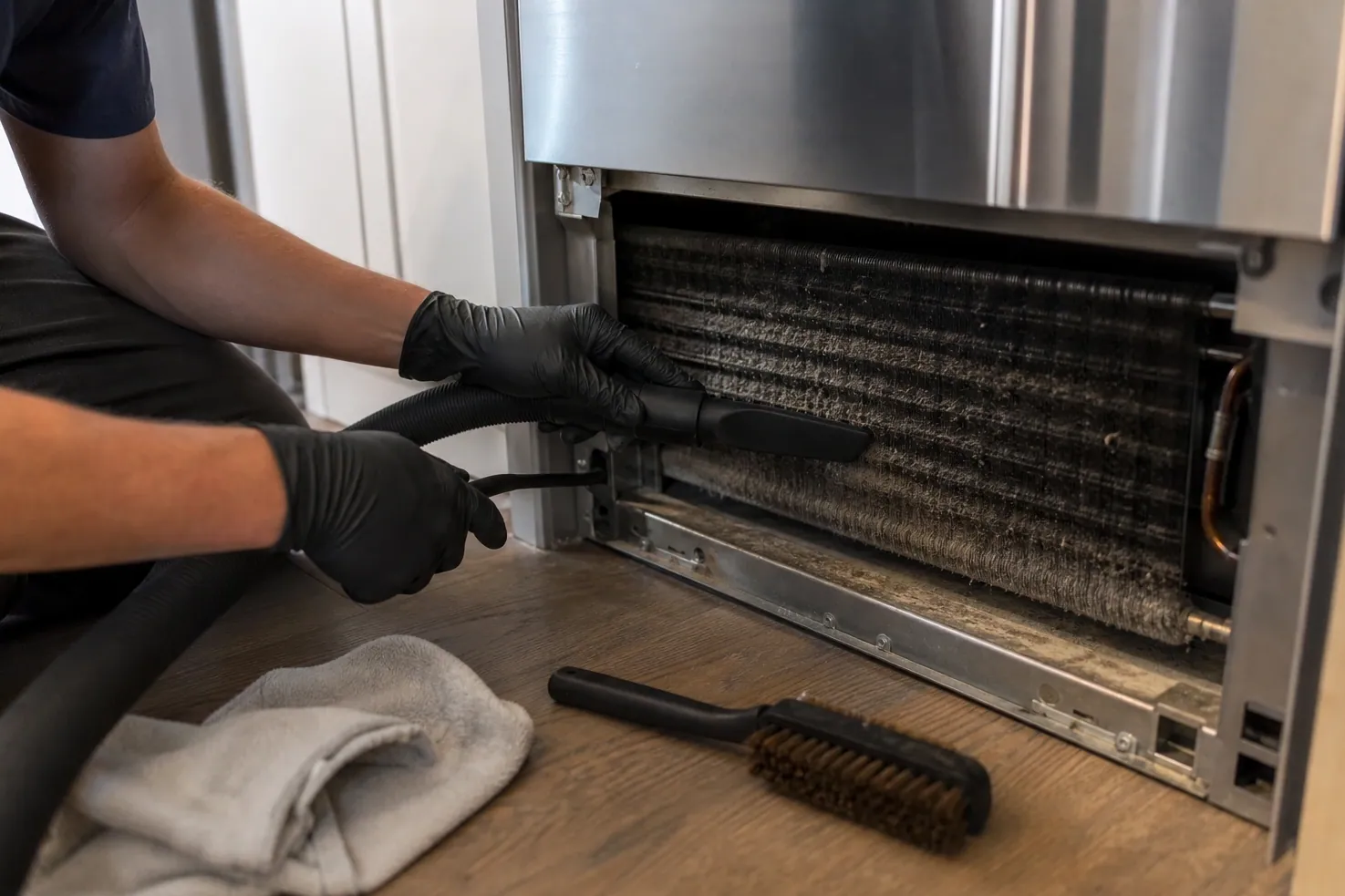
A dust-clogged condenser is still the most common starting point even for a freezer complaint, because a choked condenser can’t reject heat and the whole cabinet loses its ability to pull down to temperature. Cleaning the condenser behind the grille is the one safe step an owner can take. The next most common freezer-specific cause is a defrost fault: if the defrost heater or sensor fails, frost slowly armor-plates the evaporator coil until air can no longer move across it, and the freezer warms even though the compressor is running. You may see heavy frost at the back wall or hear the fan straining against the ice.
A freezer that runs but never gets truly cold — soft ice cream, partially thawed items — can also point to a failing evaporator fan that isn’t circulating the cold air, or to a sealed-system issue where the system simply can’t reach freezing temperatures. An overpacked freezer or a door that no longer seals will mimic these symptoms by letting warm air in and blocking airflow, so those are worth ruling out first.
What NOT to do
- Don’t chip or scrape ice off the evaporator or coil — you can puncture the sealed system.
- Don’t defrost a suspected sealed-system fault with a hair dryer.
- Don’t overpack the freezer — it blocks the airflow that keeps it cold.
Safe owner checks
- 1 Power off and vacuum the condenser coil behind the grille.
- 2 Confirm the freezer door seals fully and isn’t blocked or overpacked.
- 3 Give the unit several hours and recheck whether it pulls back to 0°F.
- 4 If it still won’t freeze, book a diagnostic — have your model and serial ready.
If these checks don't resolve it, the next step is a diagnostic. We confirm the cause on-site; the $89 service call is waived when you book the repair, and labor carries a 365-day labor warranty.
Models and series we service
We service built-in BI-series freezers and the freezer side of over-and-under and side-by-side units, classic 600/700 generations, integrated and Designer freezer columns, and PRO-series units. Older models lean toward mechanical defrost and relay faults; newer BI and Designer units add electronic control boards and sensors that can report codes such as EC, so the diagnostic path differs by generation and serial.
What to expect from a visit
A freezer diagnostic starts with the condenser, the freezer evaporator fan and the door seal, then moves to the defrost circuit — heater, sensor and any frost armoring the coil — and, if needed, sealed-system pressures. The technician confirms whether only the freezer or both compartments are affected, identifies the actual cause before quoting, and prices it up front. Most fan, defrost and gasket repairs finish in one visit with genuine OEM parts; sealed-system work is scheduled with the proper recovery equipment.
Frequently asked questions
Why is my Sub-Zero freezer warm but the fridge is fine?
On dual-compressor Sub-Zero built-ins the two compartments cool separately, so a warm freezer with a cold fridge usually points to the freezer’s own evaporator fan, defrost heater or sensor. Vacuum the condenser first as a baseline, confirm the door seals and isn’t overpacked, and if the freezer stays warm after a few hours it needs a diagnostic on those freezer-specific components.
What should a Sub-Zero freezer temperature be?
A Sub-Zero freezer should hold around 0°F (about -18°C) for proper food safety and ice cream that stays firm. If yours is reading well above that, or if frozen items are soft or partially thawed, the freezer isn’t pulling down correctly. Give it several hours after any check to recover; if it still can’t reach 0°F, the cause is mechanical and a diagnostic is the next step.
Why is there heavy frost in my Sub-Zero freezer?
Thick frost armoring the back wall usually means a defrost fault — a failed defrost heater or sensor lets frost build on the evaporator coil until it blocks airflow, and the freezer warms even though the compressor runs. Don’t chip at the ice; that risks puncturing the sealed system. A technician confirms the defrost component, clears the coil safely, and replaces the failed part with an OEM one.
Can a dirty condenser stop the freezer from freezing?
Yes. A dust- and grease-clogged condenser can’t shed heat, so the whole unit — including the freezer — struggles to pull down to temperature and runs longer and longer. Vacuuming the coil behind the grille once or twice a year is the single most effective thing an owner can do. If both compartments are warm, the condenser is the first thing to rule out before assuming a sealed-system failure.
My freezer runs constantly but stays soft — what does that mean?
Constant running with poor freezing usually means the freezer can’t move enough cold air or the system can’t reach freezing temperatures. The common causes are a failing evaporator fan, a frost-blocked coil from a defrost fault, or a sealed-system problem. Rule out an overpacked freezer and a worn door seal first; if it still won’t firm up, the fan, defrost circuit or sealed system needs testing.
Is a Sub-Zero freezer that won’t freeze worth repairing?
Almost always yes for built-in units — they are engineered to be serviced rather than discarded, and a fan, defrost part or gasket costs a fraction of a replacement that also means new cabinetry work. We confirm the actual cause first; the $89 service call is waived with the repair, labor carries a 365-day warranty, and we use genuine OEM parts.